
 Video Messages
Record personal videos to reach more customers.
 Video Agent New
Automatically send personalized videos with agentic AI.
 Vidyard Hosting
Manage all your business videos in one central spot.
 Vidyard AI Avatars
Generate personalized AI videos at scale.
 Vidyard HubsSee All Features →
Curate and share your best videos in one branded page
 Prospecting and Intros
Stand out and improve response rates.
 Sales
SalesGenerate more pipeline and close more deals.
 Post-Sales
Keep customers engaged after the deal closes.
MarketingHost video content and convert viewers into leads.
 Converting and Closing
Connect with buyers and close more deals.
 Corporate Comms
Create and deliver an internal communications strategy.
See Vidyard in Action →
“Personalized Vidyard video messages drove an 8x improvement in click-through rates and a 4x improvement in reply rates.” Read More
 Blog
BlogThe secrets to virtual selling and video best practices.
Video Agent HubCase studies and how-to videos for every revenue use case.
 Help Center
How-to and help articles for all things Vidyard.
 Fast Forward
Expert advice on all things virtual selling.
 Use Cases
Explore real ways to use video across your business.
AI Resource HubGuides and ideas for using AI in your workflow.
 Case Studies
Learn how our customers win more with Vidyard.
 Live Workshop Series
Showing you exactly how to put video to work.


Stop Losing Meetings You Already Earned
May 7, 2026
·
6 min read

Stuti Dutt
A practical playbook for turning scheduling into revenue.
The hard part is over… or so you think.
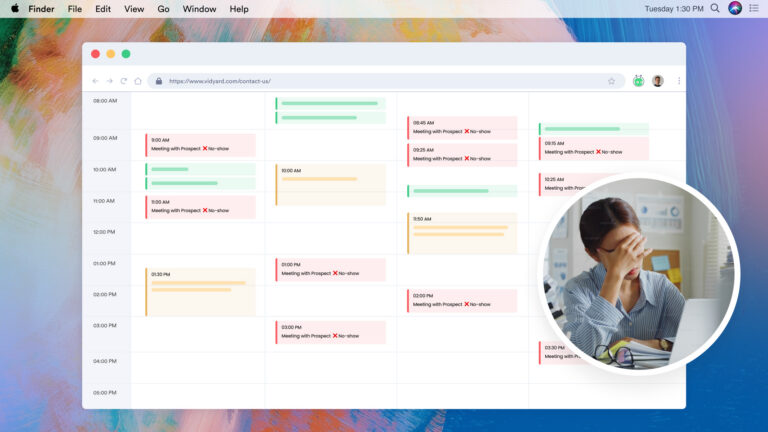
A prospect clicked your ad, responded to your outreach, or filled out your form. They made it all the way to your booking page, the moment of highest intent in your entire funnel.
And then one of two things happens:
- They don’t book
- Or they book… and never show
Either way, that opportunity disappears.
Most teams accept this as normal. It isn’t.
This is one of the most overlooked sources of revenue leakage in sales—the gap between interest and actual conversation. And fixing it doesn’t require more pipeline. It requires a better way to manage what happens after intent is created, but before the meeting actually happens.
This is where pipeline quietly breaks
Let’s put some numbers behind it.
Meeting held rates in B2B sales typically sit between 60–80%. That means even strong teams lose 20–40% of the meetings they book. Multiply that by your average deal size, and you start to see the real cost—not as a percentage, but as a revenue number sitting uncaptured every single month.
On the front end, the drop-off is just as costly. 78% of buyers go with the first company that responds to them, and conversion rates drop dramatically (up to 8x) when follow-up is delayed by just five minutes. A warm lead at 10am is effectively cold outreach by 11am if nothing meaningful has happened in between.
This isn’t a top-of-funnel problem. It’s a pipeline protection problem—and it lives in a part of the sales process most teams treat as infrastructure rather than strategy.
The real issue: scheduling is treated as a passive step
Most teams treat scheduling like admin:
- A calendar link
- A confirmation email
- A reminder notification
But from the buyer’s perspective, this is a decision journey, not an admin step. And across that journey, there are four moments where things break:
- They visit your booking page but don’t schedule
- They book, but feel no connection to the meeting
- The meeting gets deprioritized before it happens
- They miss the meeting and never come back
Each of these moments is predictable. Each one is fixable. But only if you treat scheduling as an active communication sequence, not a passive workflow.
The shift: treat scheduling like a conversion journey
High-performing teams approach this differently. They don’t rely on generic system messages. They design a sequence of touchpoints that guide the buyer from intent to attendance.
And increasingly, reps use video to do it because it combines speed, personalisation, and human connection in a way no text-based email can replicate. People retain 95% of a message when they watch it in a video, compared to 10% when reading text. And closed deals involve webcam usage 41% more often than lost deals, according to Gong data.
The key isn’t “use video more.” It’s to use the right type of video at the right moment.
1. When someone doesn’t book → recover the moment
What’s happening: A prospect lands on your booking page but doesn’t schedule.
What breaks today: There’s no meaningful follow-up, or it comes too late. By the time someone reaches out, the moment of intent is gone. A generic automated email that arrives hours later could have been written for anyone.
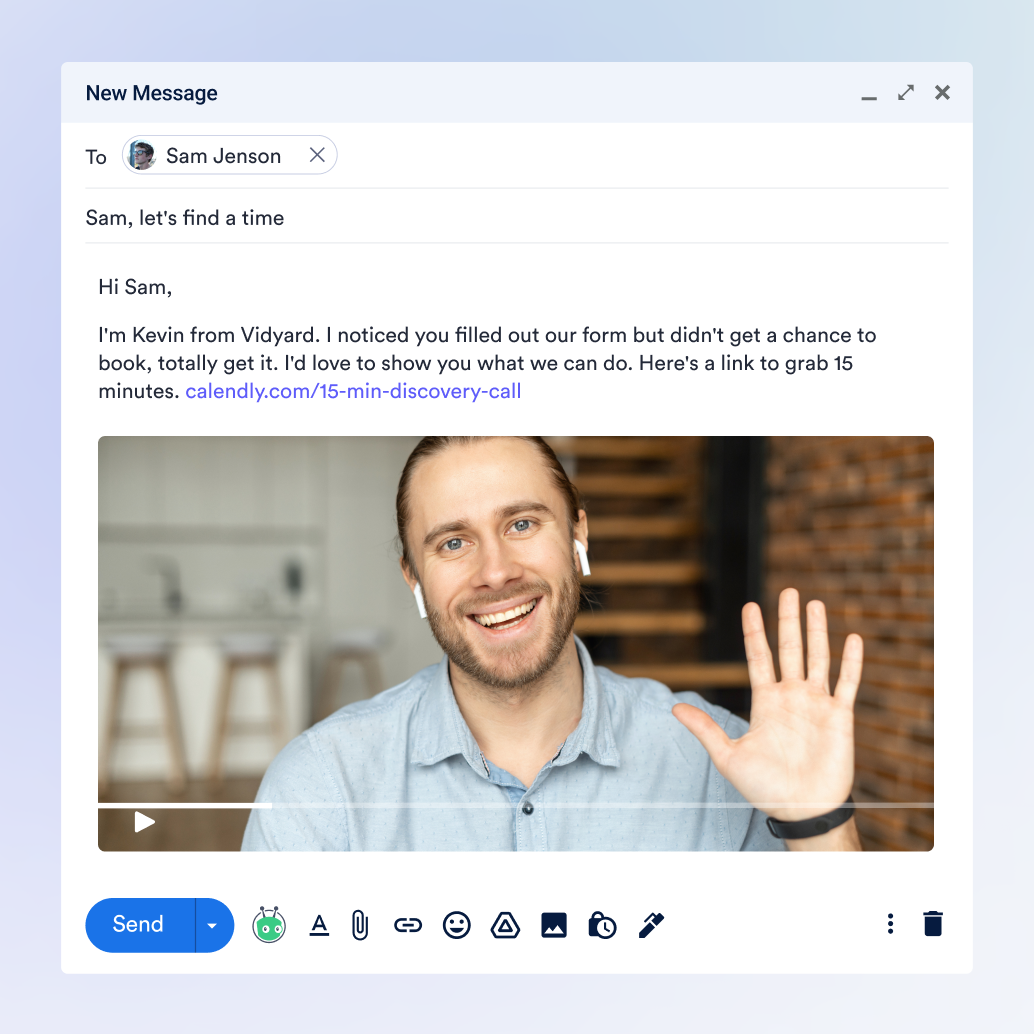
What high-performing teams do differently: They respond within minutes—not with text, but with a personalised video that feels human and immediate. This typically includes a quick face-to-name introduction, a clear statement of value, and a direct link to rebook.
The goal isn’t pressure, it’s continuity. Instead of feeling like they dropped off, the prospect feels like: “Someone noticed, and they’re worth hearing from.”
This is where automation earns its place. Trigger-based workflows—connected to tools like Chili Piper, Calendly, or HubSpot Meetings—can detect a scheduling drop-off and fire a personalised video within minutes, without any rep action required. The pattern works regardless of your stack; what matters is that the response is fast and human-feeling. For a deep dive on exactly how this workflow runs end-to-end, read: Re-Engage Meeting Abandons Before They Go Cold.
Outcome: Recovered pipeline from prospects who would otherwise disappear.
Proof: In Vidyard’s own booking abandonment workflow, 1 in 4 of the prospects who dropped off without scheduling converted to MQLs through automated video follow-up, with no rep action required.
2. When a meeting is booked → build commitment early
What’s happening: The prospect schedules a meeting.
What breaks today: They receive a confirmation that feels transactional—a date, a time, a link. There’s no connection to the person they’re about to meet, and nothing that makes the conversation feel worth showing up for. For a prospect who booked under mild interest, that confirmation does nothing to deepen their commitment.
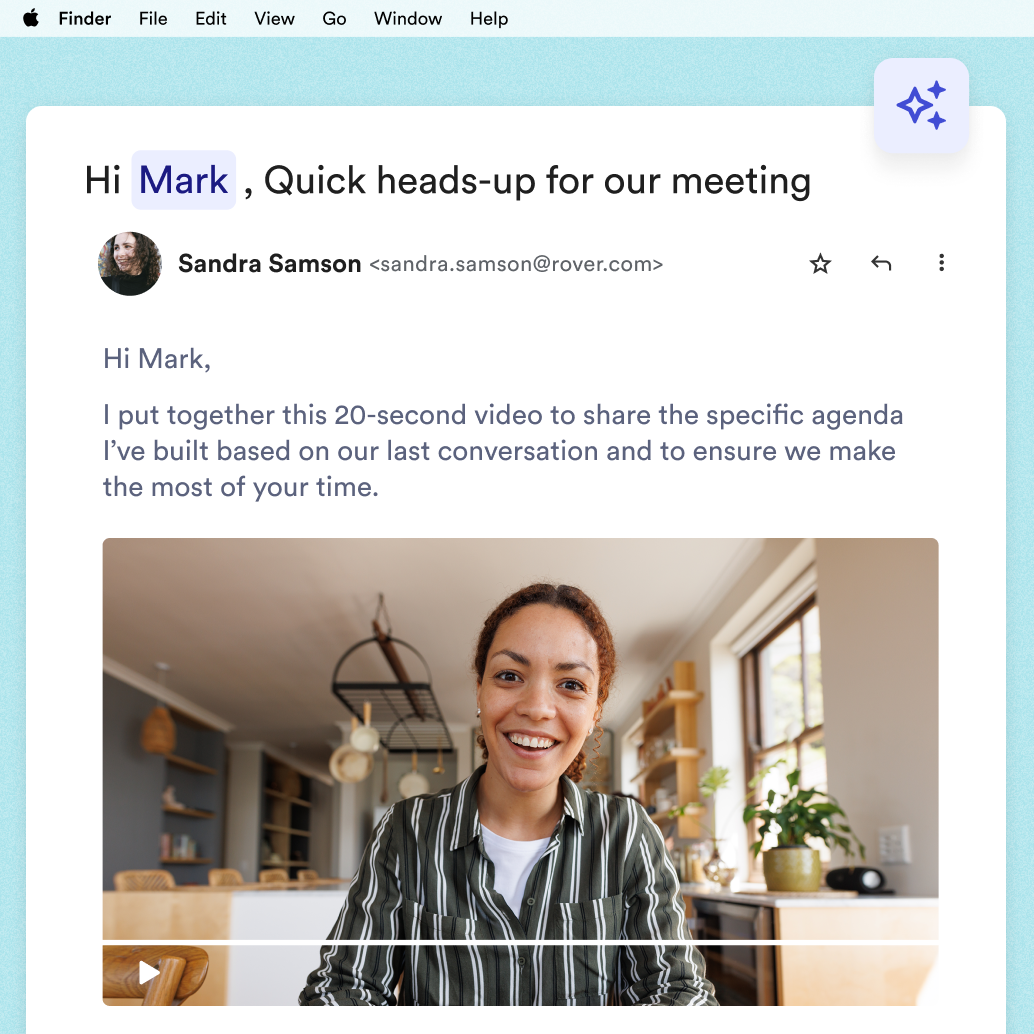
What high-performing teams do differently: They immediately follow the booking with a short, personalised video confirmation. This video introduces the rep by face and name, sets expectations for the meeting, and reinforces why the conversation is worth the time.
It turns a confirmation into a relationship-starting moment. When someone sees who they’re meeting, the interaction becomes social, not transactional. And social commitments are harder to ignore.
Vidyard’s own team tested this workflow internally and reduced their no-show rate from 13% to 9%—a 33% reduction—within the first month. As Monica Zhang, Senior Demand Generation Specialist at Vidyard put it: “The prospect gets to pre-meet the SDR they’ll see on the call, which creates a more seamless experience.”
Outcome: Higher show rates, better-prepared prospects, stronger first conversations.
Proof: Vidyard and Salesloft data found that personalised video confirmations reduce no-show rates by 30% in B2B sales environments.
3. Before the meeting → reinforce why it matters
What’s happening: The meeting is approaching—usually 24 hours out or the morning of.
What breaks today: A calendar notification fires. It gets dismissed. The prospect is in back-to-backs, something more urgent has come up, and your meeting slides to the bottom of their mental priority list. There was nothing between the booking and this moment to make the conversation feel worth protecting.
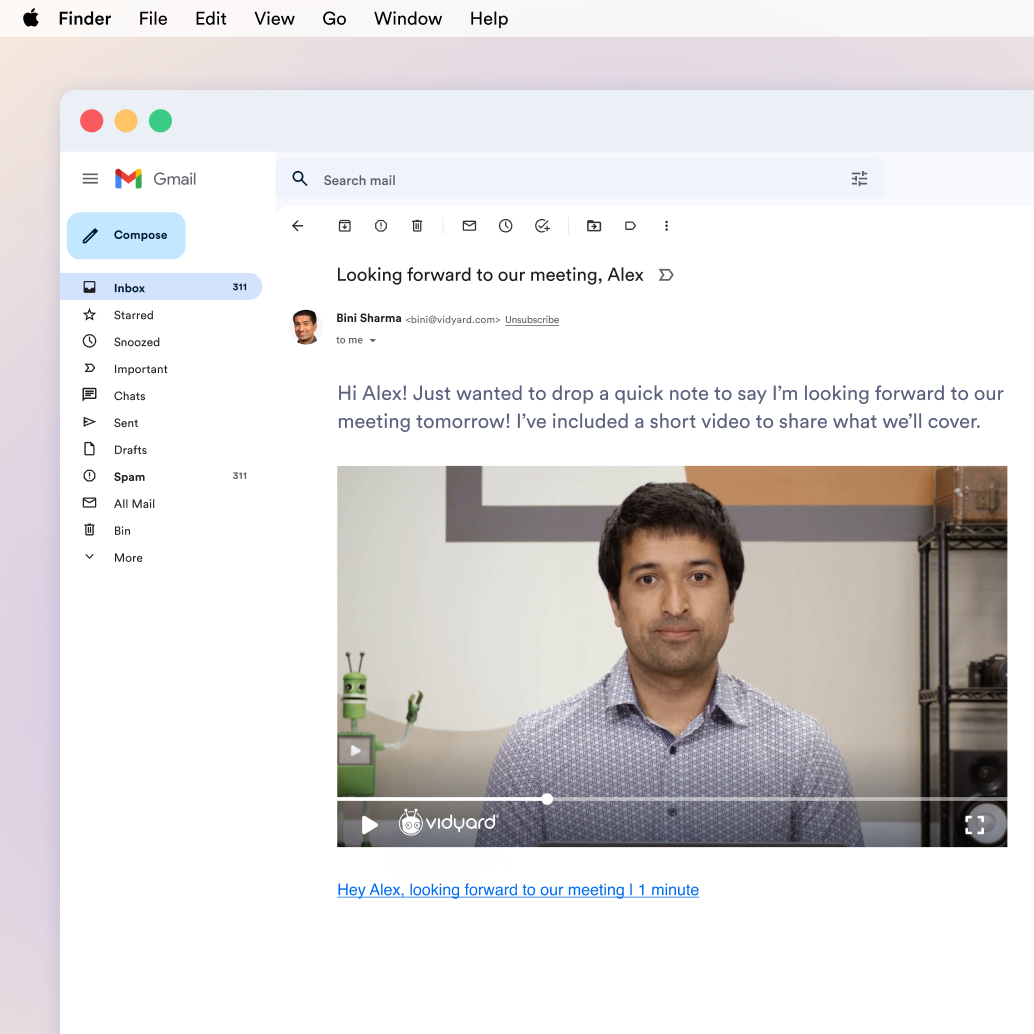
What high-performing teams do differently: They send a short pre-meeting video that reframes the meeting from another calendar event into a useful, relevant conversation. Not just “don’t forget”—but: here’s what we’ll cover, here’s why it’s worth your time, here’s how to come prepared. The tone matters, as Vidyard’s VP of Revenue Dan Wardle describes it: “Because you aren’t sending a faceless ‘are we still on?’ email, recipients feel guilty and accountable. They’re going to either show up or reschedule.”
For high-value deals, this is a moment for a rep to record something specific. For high-volume teams, AI-assisted personalisation makes it possible to give every meeting a personal-feeling reminder without the manual overhead.
Outcome: Higher attendance and more engaged conversations from day one.
Proof: Salesloft’s Jordan LeuVoy found that adding a simple pre-meeting webcam video cut his no-show rate by over 20%.
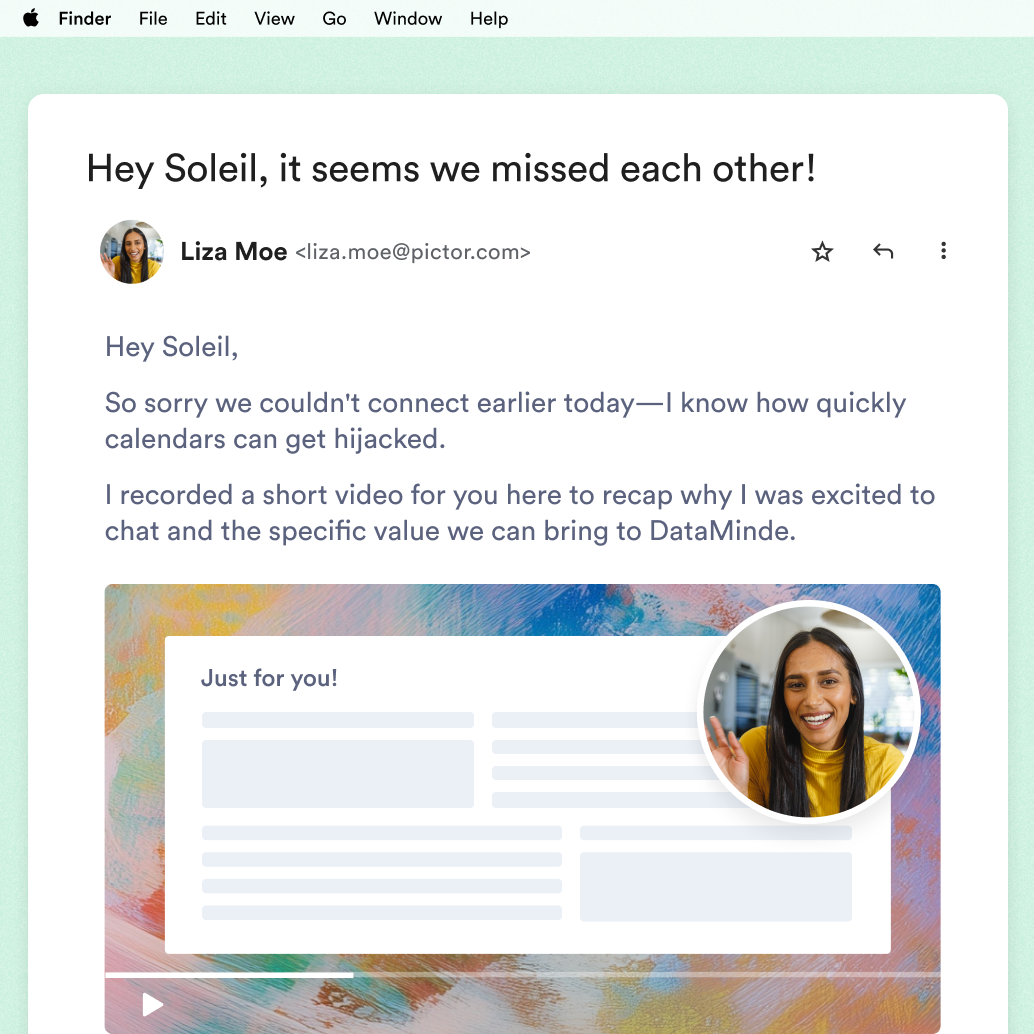
4. When someone doesn’t show → recover the opportunity
What’s happening: The prospect misses the meeting.
What breaks today: The follow-up is either generic (“sorry we missed you”), delayed, or doesn’t happen at all. The opportunity quietly dies, even though this was a qualified prospect who liked you enough to book time.
What high-performing teams do differently: They follow up quickly—same day, ideally within the hour—with a short, warm video that acknowledges the miss without pressure, restates why the conversation matters, and makes rebooking frictionless with a direct link.
The tone matters as much as the speed. No guilt, no passive aggression, just: something came up, I get it, here’s why it’s still worth connecting.
A no-show rarely means “not interested.” It usually means something got in the way. Pre-meeting reminders and no-show recovery videos are consistently cited by sales practitioners as among the highest-ROI video touchpoints in the entire sales cycle. The prospect raised their hand once. A fast, human follow-up gives them the opportunity to raise it again.
Outcome: Recovered pipeline from qualified prospects who would otherwise go dark.
Proof: Vidyard’s own no-show recovery data makes the case clearly. Across hundreds of prospects who missed a live event and received a video follow-up, 63% converted to MQL. A no-show isn’t a dead end. For qualified prospects, it’s often just a timing problem, and a fast, human video follow-up is what turns it into a second chance.
What this looks like as a system
When these four moments are handled intentionally, scheduling stops being a passive funnel and becomes a conversion system.
| Moment | What happens | Type | Outcome |
| Didn’t book | Fast, personalised follow-up | Automated | Recapture intent |
| Booked | Human confirmation video | Automated | Reduce no-shows |
| Pre-meeting | Value-driven reminder | Manual or AI-assisted | Increase attendance |
| No-show | Immediate re-engagement | Manual | Recover pipeline |
The first two moments are set-and-forget—once the workflow is configured, they run without rep input. The last two benefit most from a human touch, because the prospect is in a moment of friction and a personal-feeling message lands differently than a triggered workflow.
The combination is what makes this scalable. Reps aren’t recording 60 videos a day. The system handles the predictable moments; reps show up for the ones where their presence matters most.
The bigger opportunity
Most pipeline conversations focus on generation: more leads, better targeting, higher reply rates. Those conversations matter. But some of the highest-impact gains come from protecting what you’ve already created.
The scheduling journey is one of those opportunities. And for most teams right now, it’s leaking.
To close the gap, teams typically need three things working together: trigger-based workflows tied to buyer behaviour, the ability to personalise video without heavy manual effort, and visibility into who watched, when, and how much—so reps can follow up with context, not guesswork.
Protect the pipeline you already earned
The meetings are already there. The intent is already there. The opportunity isn’t to create more, it’s to make sure they happen.
Start with one question: Where are we losing meetings today?
Map your current scheduling journey. Identify where communication breaks down. Introduce the right touchpoint at that moment. Then build from there.
Want to see how automated video workflows support the meeting conversion journey? See it in action.