
 Video Messages
Record personal videos to reach more customers.
 Video Agent
Automatically send personalized videos with agentic AI.
 Vidyard Hosting
Manage all your business videos in one central spot.
 Vidyard AI Avatars
Generate personalized AI videos at scale.
 Vidyard HubsSee All Features →
Curate and share your best videos in one branded page
 Prospecting and Intros
Stand out and improve response rates.
 Sales
SalesGenerate more pipeline and close more deals.
 Post-Sales
Keep customers engaged after the deal closes.
MarketingHost video content and convert viewers into leads.
 Converting and Closing
Connect with buyers and close more deals.
 Corporate Comms
Create and deliver an internal communications strategy.
See Vidyard in Action →
“Personalized Vidyard video messages drove an 8x improvement in click-through rates and a 4x improvement in reply rates.” Read More
 Blog
BlogThe secrets to virtual selling and video best practices.
Video Agent HubCase studies and how-to videos for every revenue use case.
 Help Center
How-to and help articles for all things Vidyard.
 Fast Forward
Expert advice on all things virtual selling.
 Use Cases
Explore real ways to use video across your business.
AI Resource HubGuides and ideas for using AI in your workflow.
 Case Studies
Learn how our customers win more with Vidyard.
 Live Workshop Series
Showing you exactly how to put video to work.




Turning HubSpot signals into pipeline: A smarter approach to personalized outreach
Jun 10, 2026
·
5 min read

Zoe Janssens
The signals are already there. Most teams just aren't acting on them.
There are high-intent moments happening in your funnel every day: someone downloads your whitepaper, spends real time on your pricing page, or watches most of your product demo.
These aren’t passive interactions. They’re signals of intent, and yet in most cases, nothing meaningful happens next. At best, that person gets dropped into a generic nurture sequence that has nothing to do with what they just did. At worst, they hear nothing at all.
That’s the gap. Not a lack of demand or activity, but a lack of response.
Buyers are already telling you what they care about
One of the biggest shifts in B2B sales isn’t that buyers are harder to reach. It’s that they’re doing more before you ever talk to them.
Roughly 70% of the B2B buying journey happens before a buyer ever engages with sales. They’re researching independently, consuming content across channels, and comparing solutions on their own time, through traditional search, review sites, and increasingly AI tools. They’re not disengaged; they’re just operating outside your sequence.
In the process, they’re leaving behind a trail of signals: content downloads, page visits, demo views, repeat engagement. The opportunity isn’t creating more touchpoints. It’s responding to the ones that already exist.
Why volume alone isn’t the answer
On paper, revenue teams have never been better equipped. You can build sequences faster, personalize messaging at scale, and automate large parts of your outreach, and AI is accelerating all of that.
But that’s also what’s creating the problem. When everyone can generate outreach quickly, volume goes up while differentiation goes down. Average cold email reply rates sit around 3-5%, meaning roughly 95% of cold emails receive no response. Even well-written messages are easy to ignore when they feel templated or mistimed.
It’s not that outreach isn’t working. It’s that most outreach isn’t aligned to intent.
Not all signals are created equal
If you’re going to act on signals, you need to know which ones actually matter.
Most teams rely heavily on surface-level data: email opens, clicks, page views. These are easy to track but hard to interpret. They tell you that something happened, not whether it matters.
Stronger signals go deeper: what content someone engaged with, how long they stayed, whether they came back, and where they focused their attention.
And then there are high-context signals, like video engagement. When someone watches a video, you don’t just know they showed up. You know how much they watched, what parts they cared about, and whether they re-engaged. A click tells you someone was curious; engagement depth tells you what they’re actually interested in.
The missed opportunity inside your CRM
Here’s the irony: most of this data already lives in your systems.
In HubSpot, you can see activity timelines, content engagement, campaign interactions, and detailed viewing behavior with the right video integration. But for most teams, that insight doesn’t change what happens next.
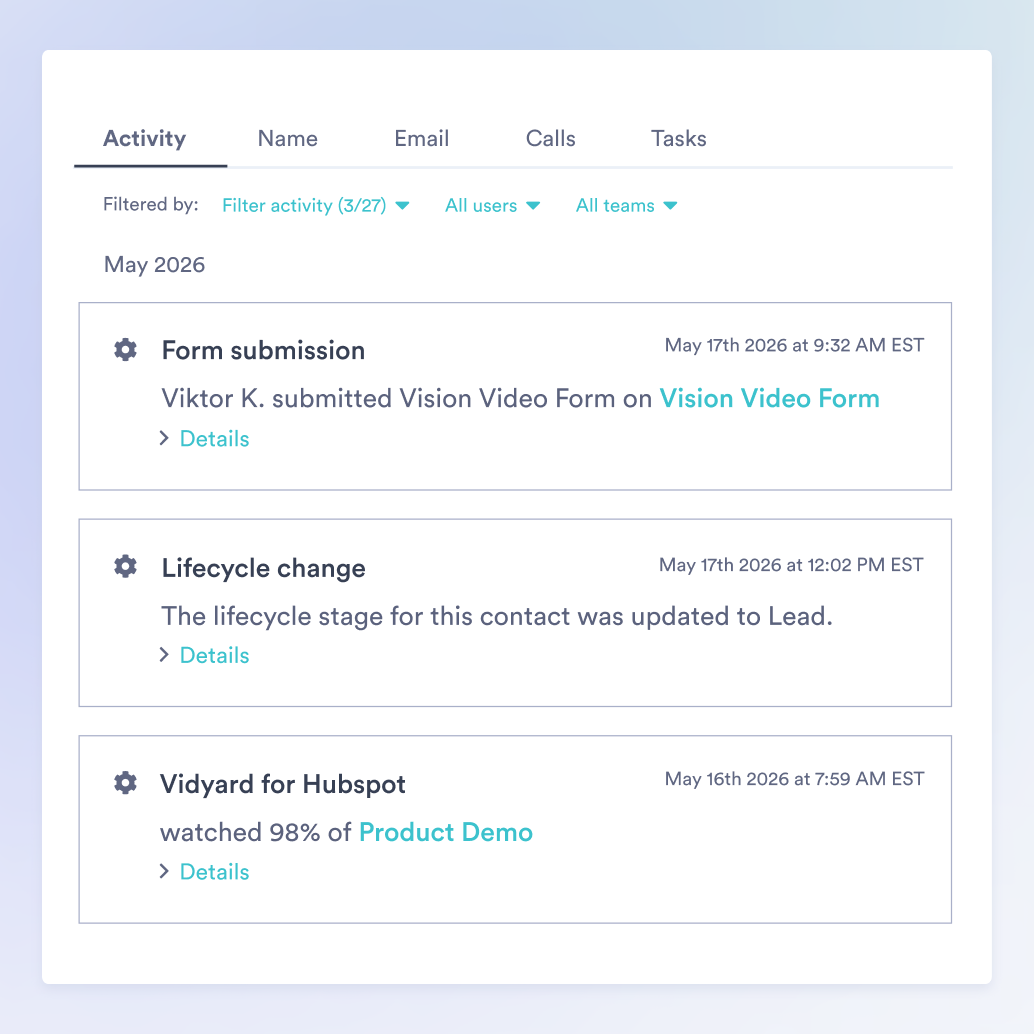
Outreach still follows fixed sequences, predefined timing, and generic follow-ups. Meanwhile, nearly 50% of sales reps never send a second follow-up, even when real engagement is happening.
Most teams are very good at tracking engagement. Very few are structured to respond to it. Here’s why:
- They treat signals as reporting data, not action triggers
- They over-index on message quality and ignore timing
- They automate volume instead of automating relevance
- They rely on sequences even when real engagement is happening elsewhere
The result isn’t just missed opportunity. It’s actively eroding relevance with buyers who have already shown interest.
A different way to think about outreach
The shift isn’t about doing more outreach. It’s about responding differently.
Instead of asking “What should we send next?”, start with “What just happened and how should we respond?” That reframe moves you from campaign-driven to signal-driven, from scheduled to responsive, from generic to contextual, and it turns outreach into a reaction to intent rather than a sequence of planned touches.
This isn’t just a sales problem, either. Marketing is already generating the signals through campaign engagement, content consumption, and website behavior. But if those signals don’t translate into timely, contextual follow-up, their impact stops at attribution. Signal-driven GTM only works when marketing and sales operate on the same behavioral insights and act on them together.
Where video becomes both signal and response
Video plays a unique role in a signal-driven model because it sits on both sides. As a signal, it tells you how someone is engaging and what they care about. As a response, it gives you a way to follow up that feels human, contextual, and differentiated.
The impact is measurable: teams using video in their outreach see up to 5x higher response rates, 4x more meetings booked, and up to a 92% increase in reply rates. But beyond the numbers, the real value is what video adds that text simply can’t convey at scale: face, tone, and context.
When you pair video engagement data with the ability to respond with a personalized video, you close the loop between intent and action.
What this looks like in practice
When you start treating signals as triggers, your motion changes. Instead of waiting for a sequence to progress, you’re responding to what’s actually happening:
- A prospect downloads a whitepaper, so they receive a short, personalized intro video from a rep
- A buyer watches most of a product demo, so they get a follow-up that references what they just saw
- A lead revisits your pricing page, so outreach reflects late-stage intent
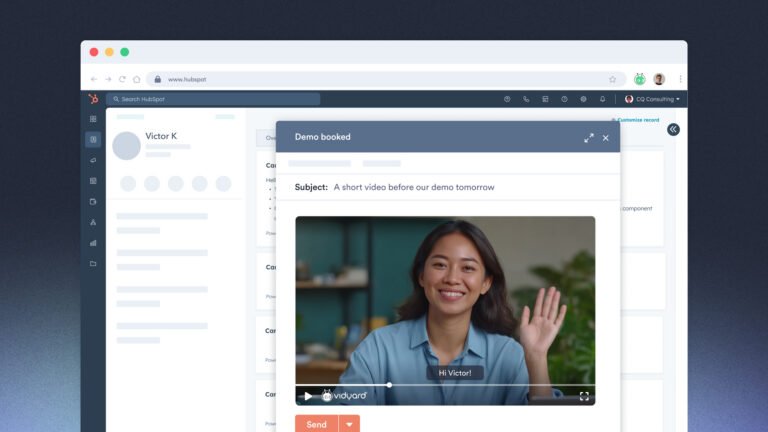
- Someone books a meeting, so they receive a personalized video before the call, building familiarity and setting the agenda ahead of time
Outreach starts to feel less like a campaign and more like a conversation that continues.
Turning HubSpot from a system of record into a system of action
Most teams already have what they need. They’re just not using it to its full potential.
HubSpot is already capturing a rich set of buyer signals: website activity, content engagement, form fills, campaign interactions. The visibility is there. But for most teams, that data is still primarily used for reporting, pipeline tracking, and retrospective analysis rather than for shaping what happens next in real time.
When a buyer shows intent, the signal gets logged and it’s visible in the timeline. But the follow-up still happens on a schedule, messaging stays the same, and timing stays disconnected from behavior.
That’s where extending what HubSpot already does well becomes valuable.
HubSpot provides the system of insight
- Centralized activity timelines
- Contact-level engagement data
- Workflow automation
Vidyard adds a layer of action and context
- Captures deeper engagement signals through video
- Surfaces intent in a more meaningful way
- Enables personalized, human follow-up
- Scales that response through automation with Video Agent
Picture this: a prospect watches a product demo embedded on your website. That interaction is already visible in HubSpot. But when you layer in video engagement data, you can see how much they watched, what they focused on, and whether they came back. Now that signal becomes actionable. Instead of waiting for the next scheduled touch, you can trigger a workflow, send a contextual follow-up, and respond while intent is still high.
It’s part of why Vidyard has been recognized as a HubSpot Essential App for Sales, helping teams turn engagement signals into timely, personalized action. When HubSpot becomes a system that not only captures engagement but responds to it, those signals stop being passive data points and start becoming pipeline.
Pipeline is created in moments, not sequences
For years, the focus has been on generating more pipeline: more leads, more campaigns, more outreach. But a significant portion of pipeline is already being signaled by buyer behavior. It’s just not being acted on in the right way.
Pipeline doesn’t happen because someone completed a sequence. It happens because you showed up at the right moment, with the right context, when someone engages deeply, shows intent, or leans in. The question is whether your system and your strategy are built to respond to those moments, or whether they’re still being missed.
The next phase of growth isn’t about doing more. It’s about responding better.
See it in action. Book a demo with Vidyard to see how your team can turn HubSpot engagement signals into pipeline.