
 Prospecting and Intros
Stand out and improve response rates.
 Sales
SalesGenerate more pipeline and close more deals.
 Sales Support
Set your sales team up for success.
 Marketing
Host video content and convert viewers into leads.
 Converting and Closing
Connect with buyers and close more deals.
 Corporate Comms
Create and deliver an internal communications strategy.
See Vidyard in Action →
“Personalized Vidyard video messages drove an 8x improvement in click-through rates and a 4x improvement in reply rates.” Read More
 Blog
BlogThe secrets to virtual selling and video best practices.
 Video Agent Hub
Case studies and how-to videos for every revenue use case.
 Knowledge Base
How-to and help articles for all things Vidyard.
 Fast Forward
Expert advice on all things virtual selling.
 Templates
Free sales templates for every stage of the deal cycle.
 FAQ
FAQGet the answers to your top Vidyard questions.
 AI Resource Hub
Guides and ideas for using AI in your workflow.
 Case Studies
Learn how our customers win more with Vidyard.






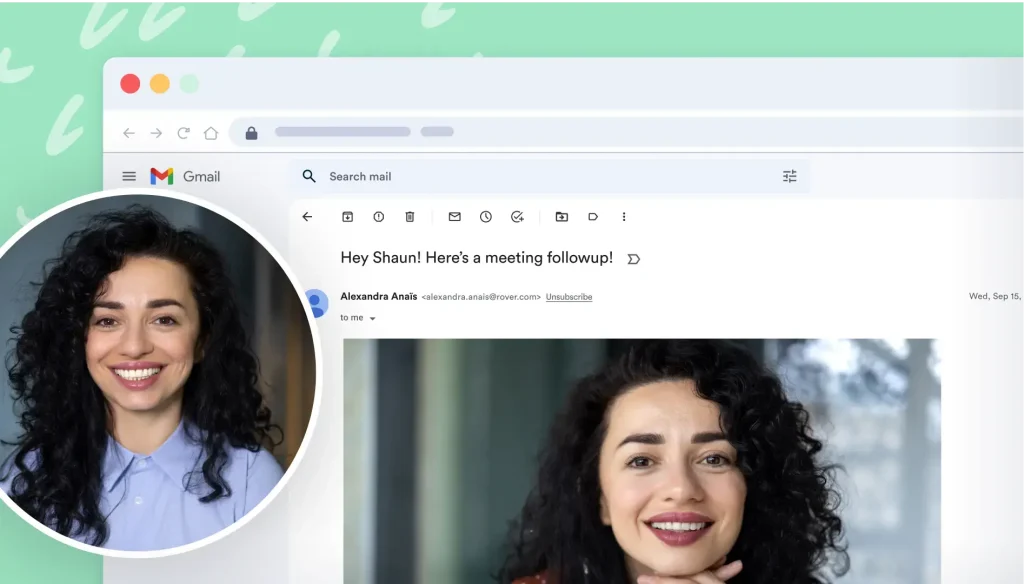

Video Agent vs AI Avatar: What’s the Difference and Which Should You Choose?
Nov 15, 2025
·
4 mins

V-Bot
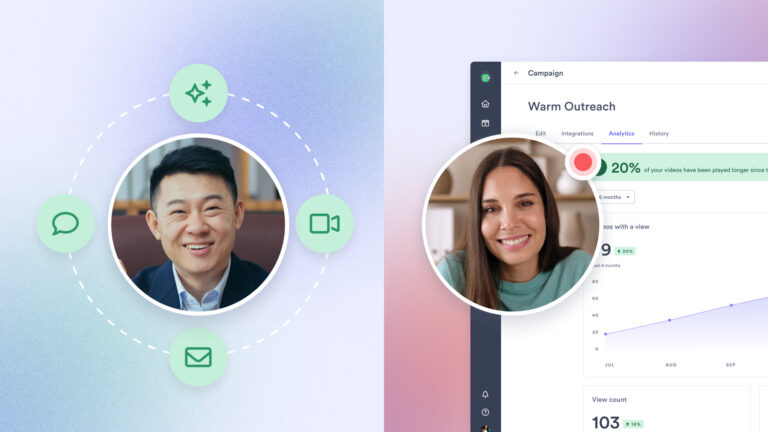
Discover the crucial differences between Video Agents and AI Avatars. Learn which AI video technology fits your sales and marketing goals with our comprehensive comparison guide.

As you evaluate how to scale personalized video for sales and marketing, you’ll come across two distinct AI concepts: Video Agents and AI Avatars. Each offers a different approach to creating and distributing video content, but they solve fundamentally different problems. One is a tool for creating video content, while the other is a system for automating video-based workflows.
Understanding the distinction is key to choosing the right technology for your goals. This article compares Video Agents and AI Avatars across key dimensions to help you make an informed choice for your go-to-market teams.
The way B2B teams use video is evolving fast — and it’s no longer just about creating content, it’s about scaling personalized engagement.
Two ways that AI is doing this today is through AI Avatars and Video Agents.
AI Avatars help revenue teams create more video content, faster — turning scripts into polished, professional videos without cameras or studios.
On the other hand, Video Agents help sales teams automate personalized outreach. They integrate directly with your sales stack including CRMs and sales engagement platforms to trigger personalized videos the moment a buyer takes action — like visiting your pricing page or downloading a guide.
Think of it this way: AI Avatars scale content production. Video Agents scale revenue impact. One helps you make more video; the other makes sure the right video reaches the right buyer at exactly the right time.
As we’re sure you know, in today’s noisy B2B landscape, timing and personalization are everything. When video becomes part of your GTM engine — not just a one-off tactic — you don’t just create content, you create connections that convert.
We’ll dive into use cases, pros and cons, and how you can get started with each type of video today.
Key Takeaways:
- AI Avatars are creation tools that help you scale video production. Video Agents are automation systems that scale your GTM motion. AI Avatars generate videos from scripts, solving content production challenges. Video Agents integrate with business software to automatically trigger hyper-personalized video actions when buyer intent is highest, addressing workflow automation needs.
- Choose based on your primary goal: scaling content vs. automating engagement. AI Avatars help marketing teams produce consistent videos for broad audiences. Video Agents enable sales teams to automate personalized outreach at scale, generating pipeline while saving seller time.
Video Agents work based on system triggers, not manual commands. AI Avatars require manual script writing and creation for each video. Video Agents automatically respond to predefined events, like pricing page visits, instantly delivering relevant videos without human intervention, maximizing engagement when buyer intent peaks.
Beyond the tech: Solving the modern B2B GTM challenge
Today’s B2B go-to-market (GTM) environment is fundamentally different than it was even a few years ago. Buyers are overwhelmed, self-sufficient, and harder to reach than ever. They conduct the majority of their research independently, and buying committees have grown larger and more complex.
Generic outreach no longer works in this reality. Blasted emails get ignored, and cold calls go unanswered. To break through the noise, personalization at scale has shifted from a “nice-to-have” to a core business necessity. The challenge for modern revenue leaders is clear: how do you deliver a timely, relevant, and human-centric experience to thousands of potential customers without hiring an army of sales reps?
This is the problem that the new wave of AI-powered video tools aims to solve. The rise of artificial intelligence in sales and marketing responds directly to these intense market pressures. Both AI Avatars and Video Agents represent attempts to make engagement more efficient and effective. Choosing between them is a strategic decision about how you want to solve the core GTM challenge of building meaningful connections in a crowded digital world.
Definitions
An AI Avatar is a realistic, computer-generated digital representation of a person used to create video content from a text script.
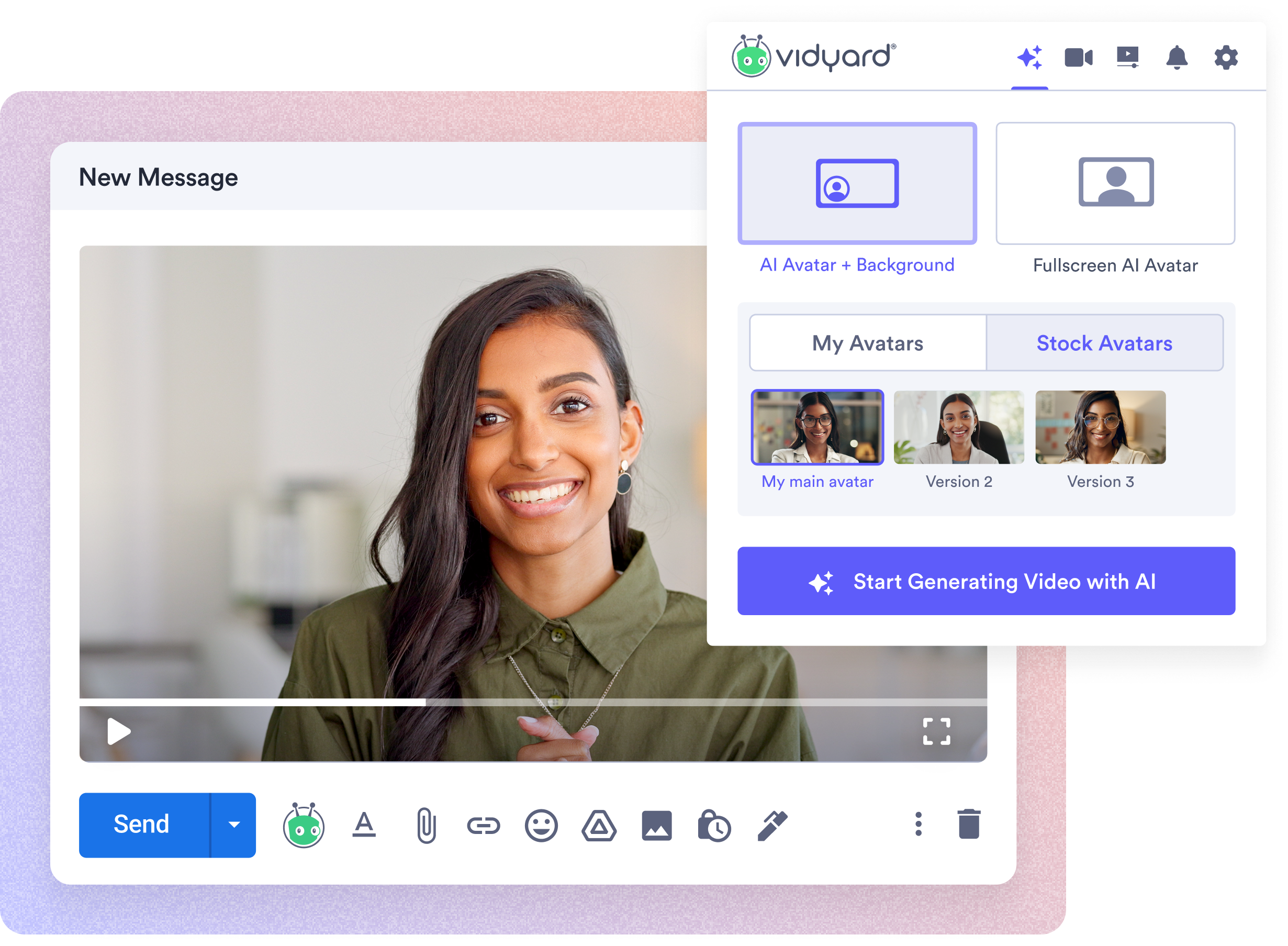
- Creates high-quality video from text, eliminating the need for cameras or microphones.
- Can be a stock avatar or a custom “digital twin” of a real person, like a sales rep.
- Enables rapid video production and easy updates to content.
- Generates polished video content in minutes, empowering sales and marketing teams to scale campaigns and outreach without production delays.
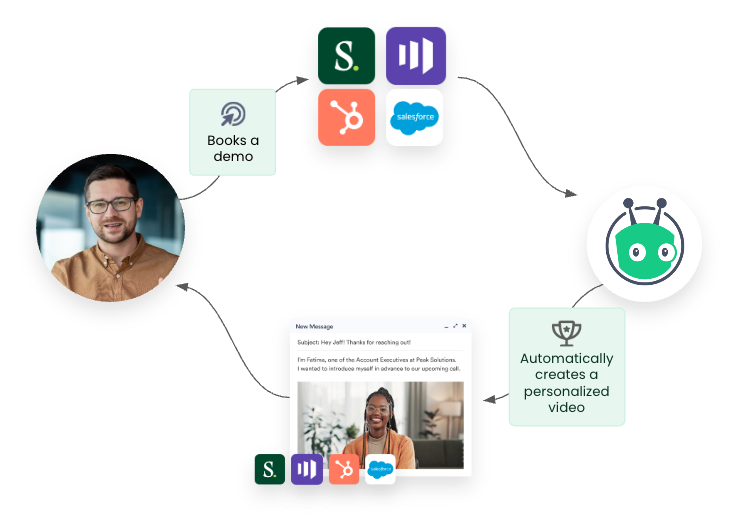
A Video Agent is an AI-powered system that autonomously triggers the creation and delivery of personalized videos based on specific events in your business software (like a CRM).
</span><span style=”font-weight: 400;”>

- Integrates with business systems like CRMs and marketing automation platforms via API.
- Executes multi-step workflows automatically, such as sending a follow-up video when a lead’s status changes.
- Operates as a background process to deliver timely, context-aware video messages without manual intervention.
Comparison at a Glance
| Criteria | AI Avatar | Video Agent |
| Definition | A digital person that generates videos from text. | An autonomous system that creates and sends videos based on workflow triggers. |
| Use Cases | Creating training modules, social media content, and product demos. | Automating sales prospecting, lead follow-up, and customer onboarding sequences. |
| Strengths | Scalable video creation, brand consistency, cost-effective production. | Automated delivery, real-time personalization, workflow integration, frees up seller time. |
| Limitations | Requires manual distribution; can lack emotional nuance without careful scripting. | Requires initial setup and integration with existing systems (e.g., CRM). |
| Complexity | Simple | Initial integration required; runs automatically thereafter |
| Ideal For | Marketing and content teams needing to produce video content at scale. | Sales and revenue teams automating high-volume touchpoints to free up reps for closing. Accelerates lead conversion, deal velocity, and onboarding efficiency. |
The evolution of video for sales: from content creation to revenue automation
Video has come a long way in sales. Each phase has made it easier to connect with buyers and reduce the manual work needed to do it.
Phase 1: Manual, one-to-one video
Tools like Loom and BombBomb helped reps create personal outreach videos that built real connections, but they don’t scale. Every message requires setup, recording, and sending. Authentic, yes. Efficient, no.
Phase 2: Scale video creation with AI Avatars
AI Avatars remove the production bottleneck. Marketing teams can create dozens of high-quality videos from scripts without cameras or editing. This makes consistent video content possible at scale, but distribution is still manual. Creation scales, but delivery doesn’t.
Phase 3: Automated engagement with Video Agents
Video Agents merge creation and delivery into one automated system. Integrated with your CRM, they trigger personalized videos based on buyer actions such as viewing a pricing page or downloading a guide. That means faster follow-up, more relevant engagement, and less manual work for sellers. Video shifts from something you make to something that runs automatically as part of your revenue engine.
Key differences explained
Core Function: Content creation vs. workflow automation
The most significant difference lies in their core purpose. An AI Avatar is a creation tool. Its job is to generate a video file from a script, much like a word processor creates a document. The user provides the text, and the avatar produces the video. The process is typically manual and focused on producing a piece of content.
A Video Agent, conversely, is an automation engine. Its primary function is not just to create a video, but to orchestrate an entire workflow around it. It decides when to create a video, what to say in it (often pulling data from a CRM), and how to deliver it, all based on predefined triggers. It’s an autonomous system designed to execute tasks.
Trigger: Manual input vs. system events
AI Avatars depend on manual input. A person writes or pastes a script, clicks “create,” and generates a one-off video.
Video Agents act automatically. When a buyer takes an action, such as downloading a whitepaper, the system triggers a personalized video follow-up from the assigned rep. The agent runs in the background, responding in real time.
Integration: Standalone tool vs. integrated system
AI Avatars can work on their own. You can log in, create a video, and export the file without connecting to any other system.
Video Agents rely on deep integration with your CRM and marketing tools. They use customer data to personalize messages and trigger actions based on buyer behavior. In doing so, they operate as a connected layer that coordinates activity across your sales and marketing systems.
For example, Vidyard uses its own platform as a Video Agent. When a new lead books a demo through HubSpot, Vidyard automatically generates a personalized video from the assigned rep and sends it instantly. No manual handoff required. That workflow connects CRM data, triggers, and personalized video content in one automated motion.
From point solution to GTM operating layer: A new paradigm for video
The distinction between a standalone tool and an integrated system introduces a more profound strategic concept: the shift from video as a “point solution” to video as a “GTM operating layer.”
A point solution is a tool designed to solve a single, isolated problem. An AI Avatar generator is a perfect example. Its purpose is to create a video file. It does this one job very well, but its function ends once the MP4 is downloaded. The user must then take that file and figure out what to do with it: upload it to social media, embed it in an email, or add it to a knowledge base. The tool solves the problem of video production but doesn’t address the larger strategic goals of lead engagement or pipeline acceleration.
A GTM operating layer, on the other hand, is an intelligent, integrated system that orchestrates activities across multiple tools to execute a broader business strategy. This is the paradigm of the Video Agent. It doesn’t just create a video; it connects to your CRM (the source of truth for customer data), your marketing automation platform (the engine for campaigns), and your sales engagement tool (the system of action for reps). It acts as an always-on brain that monitors for buying signals and autonomously executes the right video-powered action at the right time. This transforms video from a piece of content you use into a proactive, automated sales motion you run.
Pros and cons
| AI Avatar | Video Agent | |
| Primary Strength | Rapid video creation for consistent marketing output. | Automated, personalized video engagement at scale. |
| Pros | • Produce hundreds of videos quickly and affordably.
• Keep brand voice and visuals consistent. • Accessible for non-technical users. • Easily create multilingual content. |
• Automate repetitive follow-ups and reminders.
• Send videos based on real-time buyer intent. • Pull data from CRM for personalized messaging. • Engage leads 24/7 without manual work. |
| Cons | • Manual distribution is still required.
• May sound robotic or less human without strong scripting. • True one-to-one personalization requires additional automation. |
• Setup and CRM integration can be complex.
• Accuracy depends on CRM data quality. • Best for repeatable workflows, not standalone videos. |
| Best For | Marketing teams scaling consistent, brand-safe content. | Sales and success teams automating video-driven engagement. |
Mapping technology to the B2B revenue funnel
To make the choice even clearer, it’s helpful to map each technology to the different stages of the B2B revenue funnel. While they can sometimes overlap, each has a primary area where it delivers the most value.
Top of funnel (ToFu): Awareness & discovery
This stage is about attracting a broad audience and building brand awareness. The goal is to create scalable, engaging content that educates and informs potential buyers.
- Dominant technology: AI Avatar. AI Avatars excel here. Marketing teams can use them for content marketing at scale: creating consistent social media videos, video-based blog posts, and high-quality product overviews. Because the audience is wide and personalization is less critical, the avatar’s ability to produce large volumes of polished video content quickly is a major advantage.
Middle of funnel (MoFu): Consideration & intent
Here, prospects have become leads and are actively evaluating solutions. The goal is to engage them personally, answer their questions, and guide them toward a decision. This is where timeliness and personalization become critical.
- Dominant Technology: Video Agent. A Video Agent is the ideal engine for MoFu engagement. When a lead signals intent by visiting your pricing page, downloading a case study, or attending a webinar, the Video Agent can trigger an instant, personalized video from the assigned sales rep. This real-time follow-up helps book meetings and qualify opportunities while the lead’s interest is at its peak, transforming passive interest into active engagement through automation.
Bottom of funnel (BoFu): Decision & purchase
At this final stage, you are working with qualified opportunities to close the deal. The goal is to maintain momentum, build trust, and remove any final friction points.
- Dominant technology: Video Agent. The Video Agent continues to be a powerful tool to accelerate deals. Use cases include automatically sending personalized video reminders before a demo to reduce no-shows, delivering a video summary of a proposal walkthrough from the account executive, or triggering helpful onboarding videos the moment a deal is marked “Closed-Won.” These automated, timely touchpoints keep the deal moving and ensure a smooth transition from prospect to customer.
When to Use Each
Use an AI Avatar when your goal is…
- Content Marketing: Creating a consistent stream of video content for social media, blogs, and email newsletters.
- Training and Onboarding: Developing a library of standardized employee training videos, product tutorials, or customer onboarding guides to improve the vid learn experience.
- Product Demos: Producing clear, concise, and easily updatable demonstration videos for your products or services.
Internal Communications: Recording company updates or announcements from leadership without requiring them to be on camera for every message.
Use a Video Agent when your goal is…
- Automated Sales Prospecting: Acting as an AI SDR to send personalized video introductions to new leads the moment they enter your CRM.
- Real-Time Lead Follow-Up: Instantly responding with a relevant video when a prospect visits your pricing page, downloads a case study, or requests an AI sales agent demo.
- Reducing Meeting No-Shows: Automatically sending a personalized video reminder from the sales rep a day before a scheduled meeting. Vidyard used this workflow internally and reduced meeting no-show from 13% to 9% (a 33% decrease).
- Customer Onboarding at Scale: Triggering a series of helpful “welcome” videos to new customers as they complete different steps in the onboarding process.
Real-world examples
Marketing team using an AI Avatar
A marketing team needs to create weekly video updates for their LinkedIn page. Instead of scheduling a shoot with their social media manager every week, they use a custom AI Avatar of her. Each Monday, a content manager writes a short script with the week’s news, pastes it into an AI video generator, and produces a high-quality AI generated video in minutes. The video is then manually scheduled and posted to LinkedIn. This saves hours of production time and ensures a consistent presence, as seen in many AI avatar success stories.
Sales team using a Video Agent
A B2B software company wants to improve its response time for high-intent leads. They configure a Video Agent to monitor their CRM. When a lead from a target account list downloads their “Pricing Guide” PDF, the agent is triggered. It automatically generates a personalized video from the account’s assigned owner, saying, “Hi [Prospect Name], I saw you just downloaded our pricing guide for [Company Name]. I’m the account executive for your region and wanted to introduce myself. Are you free for 15 minutes tomorrow to discuss your specific needs?” The video is sent via email within 60 seconds of the download, capturing buyer attention at the exact moment of interest, without the rep lifting a finger.
How to choose: Your 3-step guide
- Assess Your Primary Goal: Are you trying to solve a content production problem (i.e., “We need to make more videos, faster”) or a revenue process problem (i.e., “Our reps are too slow to follow up with leads”)?
- Evaluate Your Workflow: Is your main challenge creating one-off videos for broad distribution, or is it engaging thousands of individuals with timely, personalized messages triggered by their actions?
- Consider Your Team’s Focus: If you need a powerful tool for your content marketing team to scale their output, an AI Avatar generator is a strong starting point. If you need a system to help your sales team automate outreach and close pipeline more efficiently, a Video Agent is the more appropriate solution.
Conclusion
AI Avatars and Video Agents solve different problems and aren’t interchangeable. In fact, they work together. Video Agent uses AI Avatar technology to generate personalized videos, then automates their delivery based on CRM triggers.
If your priority is to simplify video production and create high-quality video content at scale with minimal resources, an AI Avatar is the right tool. If your goal is to automate customer engagement, scale personalized outreach, and drive revenue by integrating video into your core business processes, a Video Agent is the strategic choice.
Ready to see how Video Agent can transform your sales motion? Vidyard’s Video Agent integrates natively with HubSpot and supports Salesforce, Marketo, and Salesloft. Explore Video Agent or book a demo to see automated video engagement in action.
Frequently Asked Questions (FAQs)
What is the main difference between a Video Agent and an AI Avatar?
The main difference is function and purpose. An AI Avatar is primarily a creation tool that transforms text scripts into video content with a digital replica of a person. A Video Agent is an automation system that handles the entire workflow of video creation, personalization, and delivery based on specific triggers or actions in business systems.
How do AI Avatars and Video Agents complement each other?
They work together seamlessly in a well-designed video strategy. AI Avatars provide the visual representation and content generation capability, while Video Agents provide the intelligence to determine when, how, and to whom videos should be sent. When combined, they create a fully automated system that can deliver personalized video experiences at scale without requiring human intervention for each interaction.
What are the ideal use cases for each technology?
AI Avatars excel at content creation scenarios like product demos, training videos, and standardized communications where consistency is key. Video Agents are better suited for process automation like lead follow-up, meeting reminders, and customer onboarding where timing and relevance are critical. The most sophisticated implementations use both: Video Agents determine when to send a message and to whom, while AI Avatars generate the personalized content for that specific interaction.
Based on the selected FAQs, here are additional questions that would be helpful to include:
Can AI Avatars and Video Agents integrate with our existing systems?
Yes, both technologies typically offer integration capabilities. AI Avatars often integrate with content management systems and media platforms for publishing. Video Agents are designed to integrate with CRMs, marketing automation platforms, and other business systems to access contact data and trigger personalized videos based on specific actions or events.
Vidyard’s Video Agent integrates natively with HubSpot and supports Salesforce, Marketo, Outreach, and Salesloft. The native HubSpot integration requires no webhooks or higher-tier plans. You can trigger Video Agent directly through HubSpot custom workflow actions.
What metrics should we track to measure success with each technology?
For AI Avatars, focus on content production metrics like time saved in video creation, volume of content produced, and engagement metrics on published videos. For Video Agents, track conversion metrics like response rates, meeting bookings, deal velocity, and revenue impact. Video Agents’ success is typically measured by their impact on your sales and marketing performance.
Do we need different types of expertise to implement these technologies?
Yes. For AI Avatars, you’ll need creative skills focused on script writing and video production. Video Agents require workflow design and CRM integration knowledge. Many teams work with Vidyard’s implementation team to configure Video Agent workflows, then run them indefinitely without ongoing technical support.
How personalized can each technology be?
AI Avatars offer static personalization where each script must be manually customized, though the visual consistency remains high. Video Agents provide dynamic personalization by automatically pulling data from your CRM to create thousands of unique videos tailored to each recipient’s specific information and behaviors.
What are the implementation timelines for each solution?
AI Avatars can be used immediately with minimal setup. Video Agents require one-time integration with your CRM to define workflows and triggers. Once configured, Video Agents run continuously without manual intervention, automating what sellers can’t scale manually.