
 Video Messages
Record personal videos to reach more customers.
 Video Agent
Automatically send personalized videos with agentic AI.
 Vidyard Hosting
Manage all your business videos in one central spot.
 Vidyard AI Avatars
Generate personalized AI videos at scale.
 Vidyard HubsSee All Features →
Curate and share your best videos in one branded page
 Prospecting and Intros
Stand out and improve response rates.
 Sales
SalesGenerate more pipeline and close more deals.
 Post-Sales
Keep customers engaged after the deal closes.
MarketingHost video content and convert viewers into leads.
 Converting and Closing
Connect with buyers and close more deals.
 Corporate Comms
Create and deliver an internal communications strategy.
See Vidyard in Action →
“Personalized Vidyard video messages drove an 8x improvement in click-through rates and a 4x improvement in reply rates.” Read More
 Blog
BlogThe secrets to virtual selling and video best practices.
Video Agent HubCase studies and how-to videos for every revenue use case.
 Help Center
How-to and help articles for all things Vidyard.
 Fast Forward
Expert advice on all things virtual selling.
 Use Cases
Explore real ways to use video across your business.
AI Resource HubGuides and ideas for using AI in your workflow.
 Case Studies
Learn how our customers win more with Vidyard.
 Live Workshop Series
Showing you exactly how to put video to work.






The Financial Services Advisor’s Guide to Secure, Scalable Video
Mar 17, 2026
·
8 min read

Chloe Taylor
Secure video is a must for any financial services organization. Learn how to communicate and build trust with your clients in a compliant and secure way.

Financial services relationships are built on trust and personal connection, but advisors are managing larger books of business, more channels, and tighter compliance constraints than ever. The question isn’t whether to use video. It’s how to use it in a way that’s personal enough to build real client trust, compliant enough to keep the firm out of trouble, and realistic for advisors who aren’t manually recording every touchpoint.
Security and legal compliance add another layer of complexity to virtual selling in the financial services industry. Luckily, some enterprise video platforms have implemented measures to ensure that when you create, share, and host video, you’re doing so within your company’s guidelines and legal requirements.
Financial services has been one of the biggest adopters of video creation and continues to be a strong leader in user-generated videos. According to Vidyard’s 2025 Video in Business Benchmark Report, financial services companies created 189% more videos in 2024 than the year prior, one of the highest growth rates of any industry tracked.
To ensure you can take advantage of video like so many other advisors and wholesalers, we’ve rounded up everything you need to know about secure video sharing for financial services.
Easily create, share and host videos from a secure and compliant enterprise video platform.
Table of Contents
Why security and compliance matter for financial services video
With the information-sensitive nature of financial services businesses, security and compliance are non-negotiable when protecting private client interactions.
The risks aren’t abstract. An advisor records a personalized update and it gets forwarded beyond the intended client. A prospect receives an AI-generated video with no disclosure. A rep goes off-script on camera in a way that wasn’t reviewed. Any one of these is a compliance event, a reputational problem, or both and under the scrutiny of bodies like FINRA and the SEC, financial services firms can’t afford to treat video communication as informal.
When evaluating what enterprise video platform is best for your business, both your legal team and IT department need to be part of the procurement process so that all the requirements are clearly defined from the start.
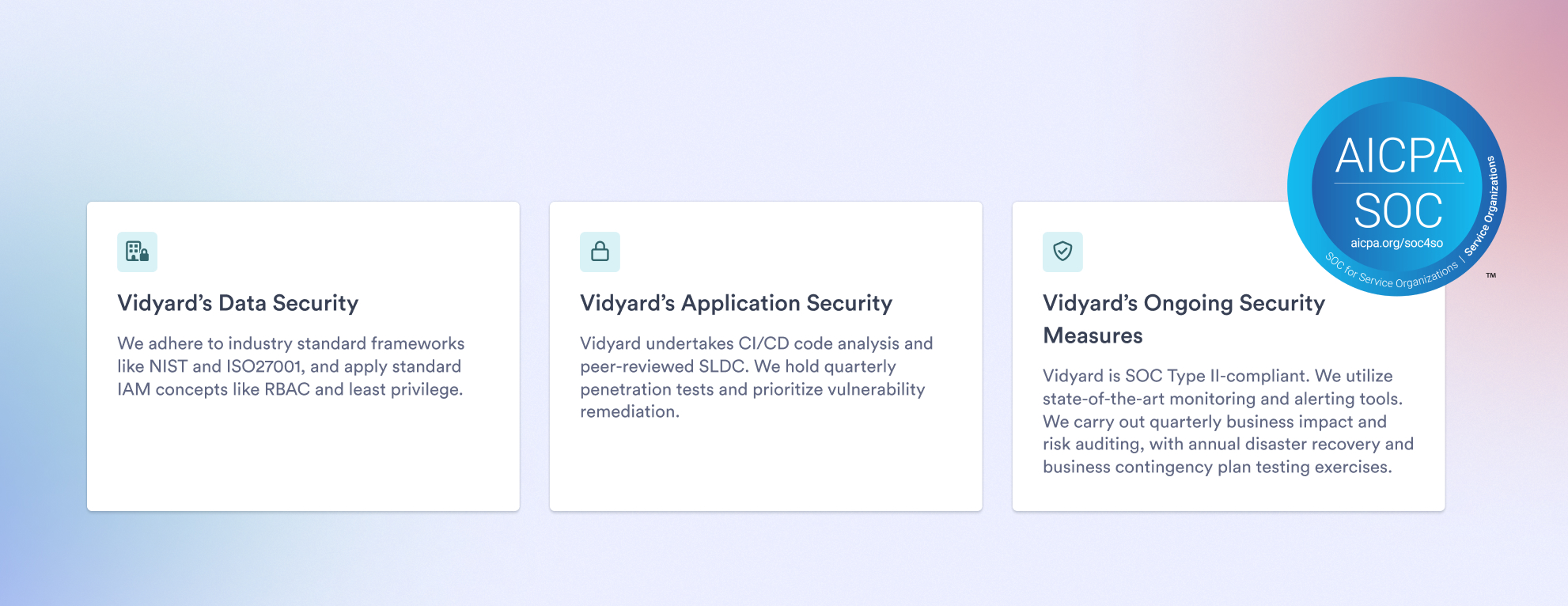
Look for a platform that has a dedicated security team and has laid out its compliance procedures. For example, at Vidyard, we know how important security is to our customers, so we created a Security Pledge to ensure direct and transparent communication with our customers.
How Vidyard keeps your firm protected without slowing you down
Here are the four capabilities any secure video platform should offer for financial services teams, and how Vidyard approaches each.
Content governance and approval workflows
Compliance doesn’t have to mean bottlenecks. With Vidyard, firms can define and approve scripts, video content, and AI Avatars before they’re used in any automated or client-facing communication. Advisors can work from pre-approved scripts and templates, so they still sound like themselves, just within guardrails your compliance team has already signed off on. That makes compliance a partner in the workflow, not a last-minute check after something has already gone out.
Role-based access and delivery controls
Not everyone on your team should have the same level of access and with Vidyard, they don’t have to. Permissions are managed by role or team, controlling who can create, edit, and deploy video content. At the viewer level, you can require password protection, restrict access to link-only sharing, set IP restrictions, or enforce SSO for internal distribution. Every interaction is tracked, giving your compliance team the audit trails and viewer analytics they need for documentation.
AI disclosure and transparency
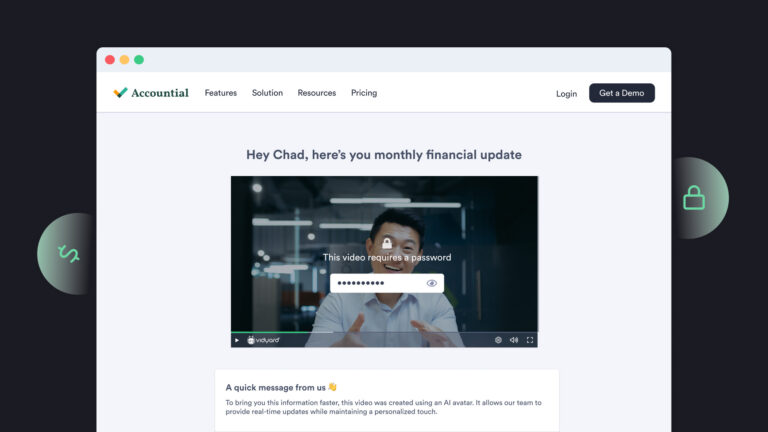
When AI Avatars are used in client communication, Vidyard applies an “AI-Generated” label so viewers know exactly what they’re watching. This is a feature that supports disclosure expectations in regulated environments. Advisors can extend their presence at scale without misrepresenting how a communication was created.
Enterprise-grade security
Vidyard encrypts video content in transit and at rest, backed by secure cloud infrastructure with compliance-ready documentation. For firms that need to understand exactly where Vidyard stands on security commitments, the Security Pledge lays it out directly.
How Video Agent makes compliant personalization scalable
Advisors managing a large book of business don’t lose clients because they don’t care, they lose touch because there aren’t enough hours to personally follow up on every meeting confirmation, onboarding step, or renewal reminder. The moments that matter most in a client relationship are also the ones most likely to fall through the cracks.
Video Agent is Vidyard’s trigger-based workflow automation tool. It is not a chatbot, a live meeting tool, or a general AI assistant. When a defined trigger fires, such as a meeting being booked, a form submitted, or a scheduled campaign milestone, it automatically delivers an approved, personalized video message through your existing CRM and communication workflows. The advisor doesn’t have to remember to send anything. The system does it for them, at the right moment, every time.
For financial services teams, this matters because consistency in client communication isn’t just good service, it’s a compliance and trust issue. A missed onboarding touchpoint or a portfolio review reminder that never went out isn’t just a gap in the relationship. It’s a gap in the record.
Vidyard used Video Agent internally to automate personalized meeting confirmation videos and reduced its own no-show rate from 13% to 9% as a result. CSI Accounting and Payroll applied the same approach to scale personalized video across their client base while maintaining the disclosure standards their industry requires.
What Video Agent delivers is consistency. The right message reaches the right client at the right moment, whether or not the advisor remembered to send it.
AI Avatars for trust-sensitive, client-facing communication
Skepticism about AI-generated communication is reasonable, especially in an industry built on personal relationships. Vidyard’s approach to AI Avatars was built with that in mind.
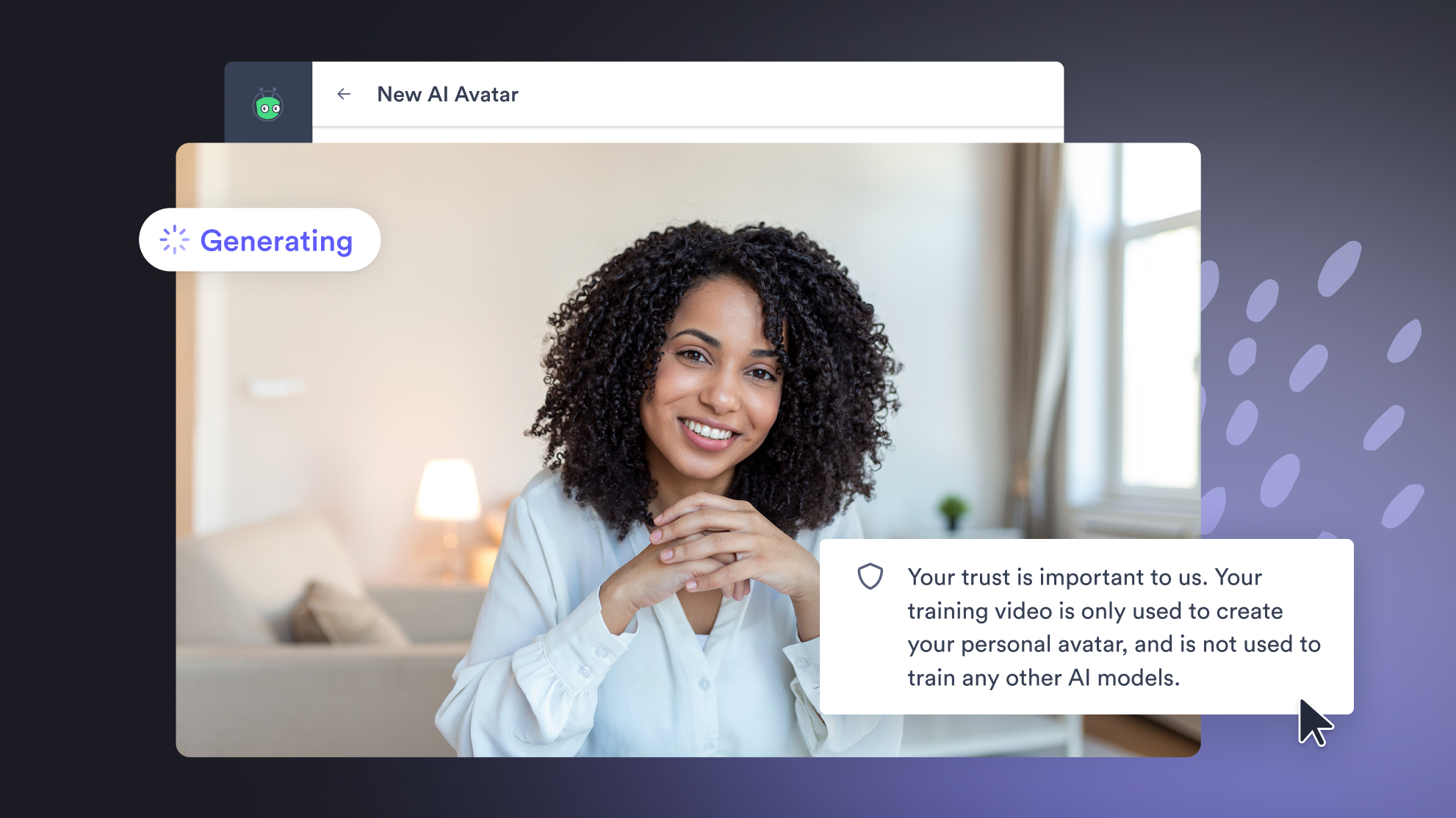
AI Avatars are hyper-realistic, AI-generated videos created from a short training clip of the real advisor, typically around 90 seconds of footage. The avatar looks and sounds like them, speaks in their voice, and can be deployed across 28 or more languages without any additional recording. For advisors serving multilingual client populations, that reach matters.
Creating an AI Avatar requires the real person’s consent, and every AI Avatar video carries an “AI-Generated” label so clients know what they are watching. That label is not buried or optional. Vidyard built disclosure into the product from the start, not as an afterthought.
AI Avatars are not a replacement for advisors. The relationship still belongs to them. AI Avatars extend their presence, allowing the right message to reach the client without the advisor having to record it each time. Combined with Video Agent’s automated workflows, an advisor records once and the touchpoints take care of themselves from there.
Secure video across the client lifecycle
Whether you are a financial advisor, an insurance agent, or a mortgage loan officer, the moments that define a client relationship follow the same pattern. Here is how video fits into each of them.
First contact and prospecting
A short webcam video in a prospecting email consistently outperforms a cold text message for response rates. Hybrid videos combining webcam and screen share let advisors walk a prospect through a portfolio overview or product comparison before the first meeting has even been booked.
Meeting preparation and confirmation
Video Agent automates personalized meeting confirmation videos triggered directly by calendar or CRM events. Clients who receive a confirmation video from their advisor are less likely to no-show. Vidyard’s own internal data backs this up, with no-show rates dropping from 13% to 9% after implementing the same approach.
Onboarding new clients
The first impression after a client commits matters. A personalized onboarding video from the advisor, delivered automatically through Video Agent on the day accounts are opened, sets the tone for the relationship before the advisor has had to lift a finger. For advisors stretched across a large book, AI Avatars allow their face and voice to be present in every onboarding communication even when bandwidth is limited.
Ongoing relationship and retention
Portfolio review reminders, annual check-in videos, and milestone acknowledgments can all be automated through Video Agent without losing the personal feel that makes them worth sending. Renewal reminders triggered from the CRM via AI Avatar keep client touchpoints consistent without adding to the advisor’s task list.
Easily create, share and host videos from a secure and compliant enterprise video platform.
Video that works for financial services
The question was never whether financial services teams should use video. It was whether they could do it in a way that builds genuine client relationships, meets the compliance bar, and doesn’t add another manual task to an already stretched advisor. Vidyard is built to answer all three.
For firms ready to see how it works in practice, book a demo with Vidyard’s team. For teams that want to explore before committing, Vidyard’s free plan includes three custom AI Avatars and access to Video Agent workflows.
Frequently asked questions
What do I tell my compliance team when they ask about Video Agent?
Video Agent uses pre-approved content and defined workflows. Compliance teams can review and approve scripts before any video is deployed, which means nothing goes out without governance already in place.
What do clients actually see when they receive an AI Avatar video?
Clients see a video that looks and sounds like the advisor, with an “AI-Generated” label so there is no ambiguity about how it was created. This is a disclosure feature built into the product from the start, not a disclaimer added after the fact. Clients know what they are watching.
How does Vidyard handle video that gets forwarded outside the intended audience?
Vidyard has access controls including password protection, link-only sharing, and IP restrictions, so distribution can be scoped to the intended audience from the moment a video is sent. Viewer-level analytics log who watched and when, giving compliance teams the documentation they need without having to chase it down manually.
What should financial services teams look for in a secure video platform?
The four capabilities that matter most are content governance and approval workflows, role-based access and delivery controls, AI disclosure features, and enterprise-grade security infrastructure. A platform built for financial services should be able to demonstrate all four clearly, not treat them as add-ons. Vidyard is built to address each of them, with a Security Pledge that sets out its commitments directly.
Does this work for insurance and mortgage teams, or just financial advisors?
Yes, and the compliance logic is often tighter in those environments. Insurance agents and mortgage loan officers face strict rules around what can be sent under their name, and Video Agent’s content governance and pre-approved scripts are built with exactly that in mind. Outreach that goes out from a loan officer’s AI Avatar always uses messaging that has already been reviewed and approved, which is the same standard these teams are held to everywhere else in their business.
This post was originally published on October 8, 2021. It was updated on Mar 17, 2026.