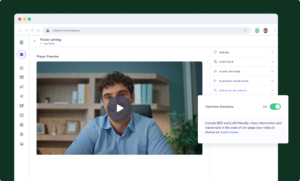

 Video Messages
Record personal videos to reach more customers.
 Video Agent New
Automatically send personalized videos with agentic AI.
 Vidyard Hosting
Manage all your business videos in one central spot.
 Vidyard AI Avatars
Generate personalized AI videos at scale.
 Vidyard HubsSee All Features →
Curate and share your best videos in one branded page
 Prospecting and Intros
Stand out and improve response rates.
 Sales
SalesGenerate more pipeline and close more deals.
 Post-Sales
Keep customers engaged after the deal closes.
MarketingHost video content and convert viewers into leads.
 Converting and Closing
Connect with buyers and close more deals.
 Corporate Comms
Create and deliver an internal communications strategy.
See Vidyard in Action →
“Personalized Vidyard video messages drove an 8x improvement in click-through rates and a 4x improvement in reply rates.” Read More
 Blog
BlogThe secrets to virtual selling and video best practices.
Video Agent HubCase studies and how-to videos for every revenue use case.
 Help Center
How-to and help articles for all things Vidyard.
 Fast Forward
Expert advice on all things virtual selling.
 Use Cases
Explore real ways to use video across your business.
AI Resource HubGuides and ideas for using AI in your workflow.
 Case Studies
Learn how our customers win more with Vidyard.
 Live Workshop Series
Showing you exactly how to put video to work.



A Video Playbook for Customer Adoption and Retention
Jun 2, 2026
·
7 min read

Stuti Dutt
Winning a customer is expensive. Keeping one is where the math actually works.
Yet most go-to-market investment is concentrated at the top of the funnel, while the post-sale experience runs lean. CSMs carry too many accounts. Communication is reactive. And the signals that predict churn often go unnoticed until it’s too late to act on them.
The result is a retention problem that doesn’t announce itself. Customers don’t always tell you they’re disengaging. Only 1 in 26 dissatisfied customers actually raises the issue. The rest churn silently. By the time a renewal conversation reveals the problem, the decision has often already been made.
Below are the four key moments in the post-sale journey where that dynamic changes, where proactive, personalized communication keeps customers engaged, educated, and moving toward renewal rather than away from it.
The real cost of getting post-sale wrong
Most post-sale failures don’t start at renewal. They start much earlier, in the silence after onboarding ends.
23% of customer churn comes from ineffective onboarding alone. Not product fit, not price, not competition. Just the failure to help customers understand and use what they bought.
Beyond onboarding, weak relationships compound the problem. Customers who feel like a ticket number rather than a partner don’t expand. They quietly evaluate alternatives.
The good news is the flip side is equally clear. Increasing retention by just 5% can increase profits by 25% to 95%. In a market where net-new growth is harder to come by, the companies best positioned to grow are the ones protecting and expanding the customers they already have.
The lever most teams underuse? Communication. Not more of it. Better communication at the moments that actually shape retention outcomes.
Why post-sale communication breaks down
Most CS teams are working with the wrong tools for the job. Email handles transactions. Decks work for QBRs, when stakeholders actually attend. Help articles work for customers who go looking for answers. But none of these formats build human connection, explain complex things clearly, or make customers feel seen across the entire lifecycle. The result is a post-sale experience that feels inconsistent, and by the time a renewal conversation reveals it, the customer has often already decided. 74% of people rely on video to learn how to use a new product or service. Video shows instead of tells, and when it comes from a real person, it builds the kind of relationship that survives a tough renewal conversation.
Four moments. One retention system.
Individually, these are useful tactics. Together, they form a repeatable system for driving adoption and retention. Some of these moments need to happen every time. Others matter most when they feel human. The highest-performing teams design for both.
| Moment | What happens | Type | Outcome |
| New customer signed | Personalized welcome from CSM | Automated | Fast time-to-value, early trust |
| Feature questions / support | Screen-recording walkthrough | Manual (reusable library) | Faster resolution, lower ticket volume |
| Quarterly review | Agenda video + hosted recap | Manual | Full stakeholder alignment, renewal readiness |
| Between milestones | Trigger-based check-ins + updates | Automated + Manual | Continuous engagement, early churn signals |
The first and last moments benefit most from automation. They’re high-frequency touchpoints where personalization at scale makes the difference. The middle two benefit most from a human touch, because they’re the moments where a CSM’s expertise and judgment add the most value.
1. Onboarding: Make value clear on day one
Finishing onboarding is not the same as activation. Completion means the kickoff call happened and the setup is done. Activation means the product has become essential to how they work. The silence after onboarding ends is where most teams go quiet and where disengagement quietly begins. Only 12% of users rate their onboarding as effective.
What breaks today: Onboarding is generic. A welcome email, a knowledge base link, a kickoff call scheduled days after signup. The customer is left to figure things out during the window when they’re most at risk of disengaging.
What high-performing teams do differently:
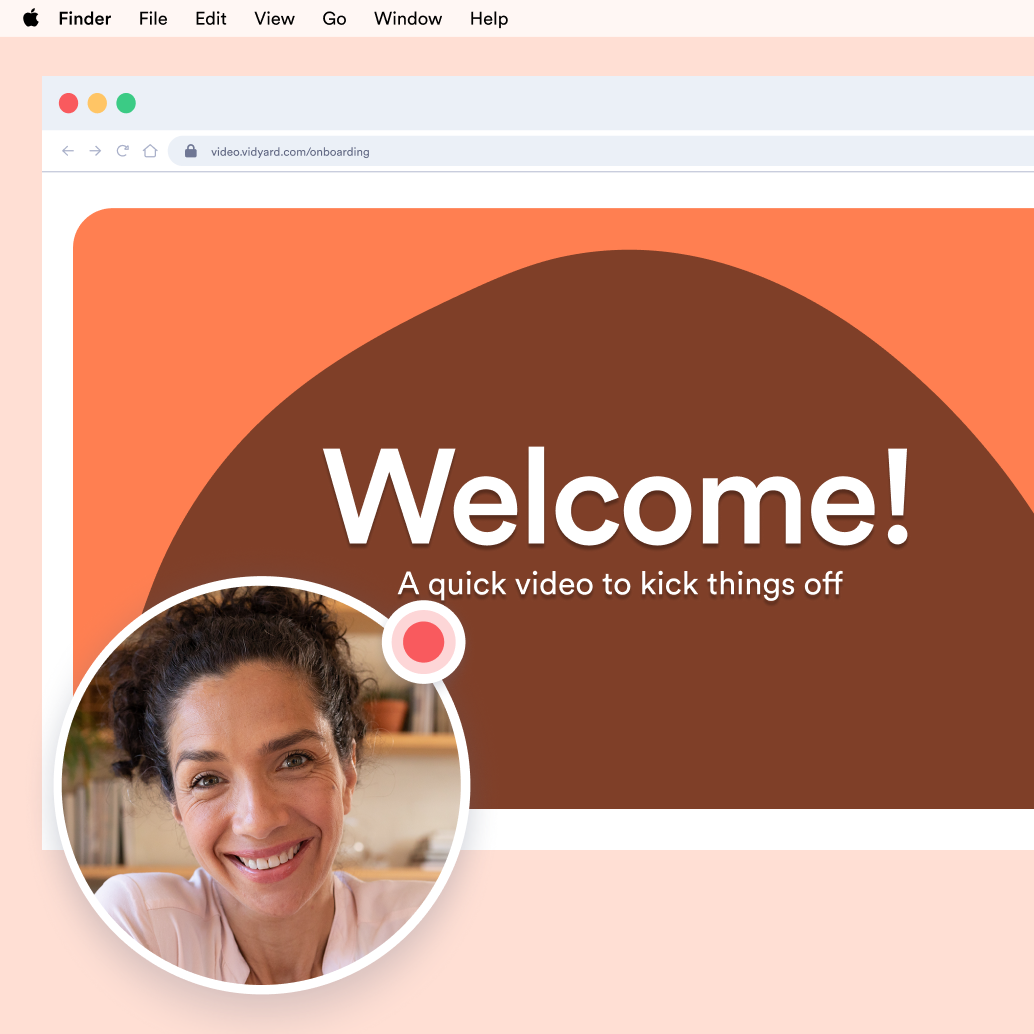
- Day 1 welcome video (recorded Message from CSM): A 60-second personal video sent within 24 hours of signing. Not a product tour. A human introduction that sets expectations and tells the customer what to do first.
- Feature trigger videos (AI Avatar at scale): When a user engages with a feature for the first time, an automated personalized video fires with a relevant tip. The message feels 1:1 because it references their specific action.
- Re-engagement videos (automated, AI Avatar): When a user goes inactive for seven days, a check-in video surfaces automatically before they disengage permanently.
- Milestone videos (recorded Message): When a customer hits a meaningful product milestone, a short congratulatory video reinforces momentum and keeps the relationship warm between formal touchpoints.
Where to begin: Start with a personal welcome video sent within 24 hours of a customer signing. Record it as a Message, keep it under 60 seconds, and cover three things: who you are, what to expect in week one, and what to do first. Once that becomes a habit, scale it with your AI Avatar so every new customer gets that same personal touch automatically. From there, layer in behavior-based triggers tied to product usage so the system shows up for customers at moments you’d never catch manually.
Outcome: Faster time-to-value, stronger early adoption, lower early churn risk.
Proof: Onboarding videos are watched 30% more deeply than the average video. That completion rate isn’t just a content metric, it’s a signal that customers are actively trying to learn, and that the format is working. When your day-one communication earns that kind of attention, you’re not just reducing early churn risk. You’re building the habit of engagement that carries through the entire relationship.
2. Product and feature walkthroughs: Show, don’t tell
When a customer doesn’t understand how to use something, how you respond shapes whether they stay or go. A text-based answer gets the question answered technically. A video walkthrough gets the customer to actually do the thing.
What breaks today: Customers get a help article or a long email thread trying to describe a visual workflow in words. For CSMs handling large books of business, this pattern becomes a time drain on both sides.
What high-performing teams do differently:
- Screen recording walkthroughs (pre-recorded, reusable): A 90-second screen recording walking through a specific workflow answers the question more clearly than ten back-and-forth emails. The customer can rewatch it, share it internally, and refer back to it later.
- Personalized intro on a reusable video (recorded Video Message): CSMs don’t record a fresh video for every question. They pull from the library and add a 10-second personalized intro before sending. High-volume efficiency, human-feeling delivery.
- Hosted walkthroughs (Vidyard Hosting): For features customers repeatedly struggle with, host short explainer videos directly in your help centre or customer portal. Customers find answers on their own, reducing inbound support volume before it starts.
Where to begin: Start by identifying your ten most-asked feature questions and record a short screen recording for each one. That becomes your library. From there, CSMs stop writing the same explanation twice and start sending a video with a quick personalized intro instead. Every walkthrough you build for one customer gets reused across your entire book of business. The effort goes in once. The value multiplies.
Outcome: Faster issue resolution, reduced support volume, stronger perceived value from the CS team.
Proof: Vidyard CS users have created over 338,000 support and documentation videos and those videos average 71 views each. That reuse rate tells the real story: a single walkthrough recorded once doesn’t answer one question, it answers that question dozens of times across a customer base without the CSM ever touching it again. The effort goes in once. The deflection compounds.
3. QBRs and value recaps: Build the case before renewal asks for it
Most teams rely on QBR decks to communicate value. The problem is, decks only work for the people who show up.
By the time a formal QBR happens, most renewal decisions are already forming. The goal isn’t to present value in a meeting. It’s to reinforce a narrative built consistently over time so the renewal conversation becomes a confirmation, not a negotiation.
What breaks today: The QBR deck gets shared. Some stakeholders attend, others don’t. The ones who weren’t in the room never see the value summary, and they’re often the ones with budget authority at renewal. The CSM ends up rebuilding the value case from scratch every quarter, for every account.
What high-performing teams do differently:
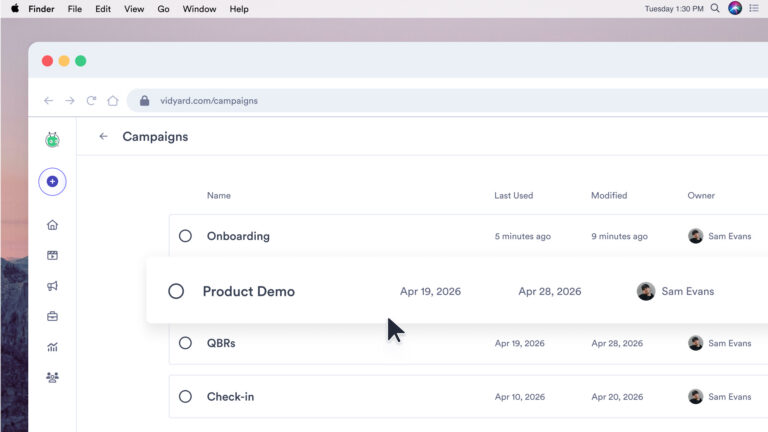
- Pre-QBR agenda video (recorded Message or AI Avatar): A short video sent to all attendees before the meeting. Covers what will be discussed, what to come prepared with, and why it matters. Attendees arrive ready and no-shows drop.
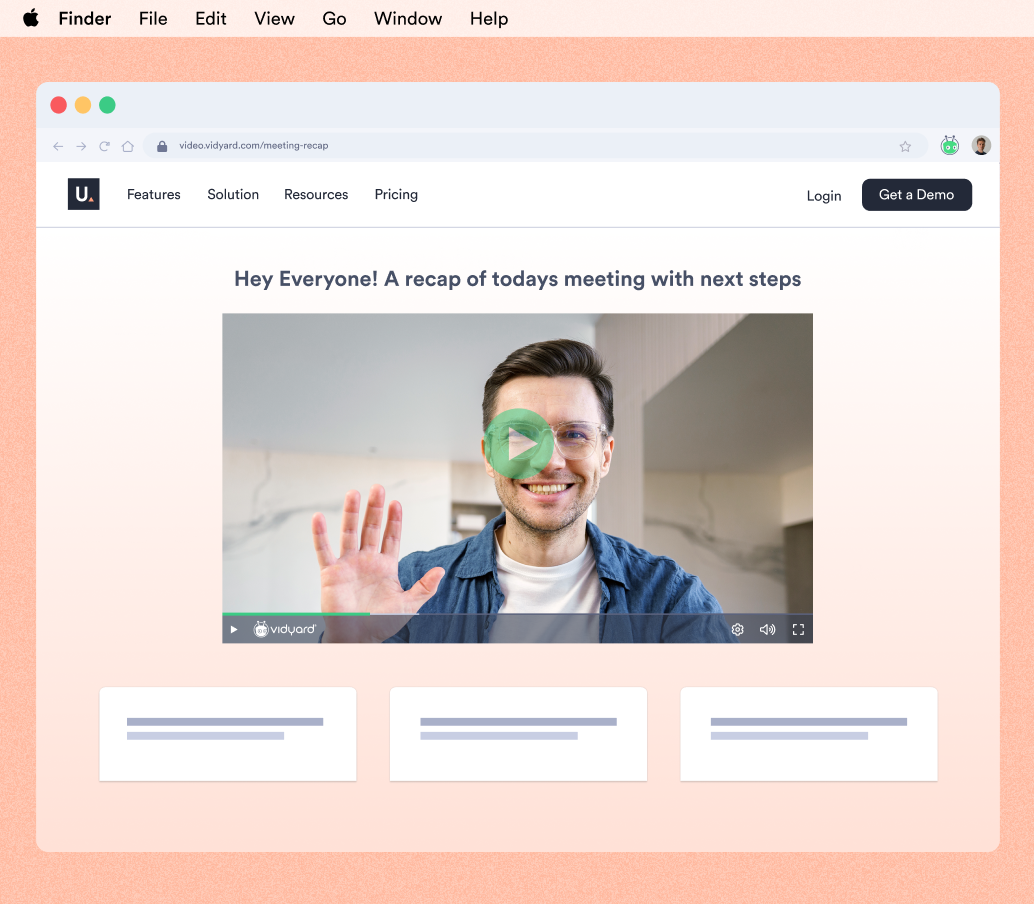
- Post-QBR recap video (recorded Message or AI Avatar, hosted): A two-minute summary of key outcomes, usage highlights, and agreed next steps. Hosted on a branded page and shared with every stakeholder including the ones who didn’t attend.
- AI-assisted talk track: Take your QBR notes or meeting transcript and use AI to draft a concise video script. Record it as a Message or run it through your Avatar. Fast enough to do after every QBR, not just the big ones.
- Between-QBR value touchpoints (AI Avatar at scale): A short video sharing a relevant stat, a new feature, or a customer milestone keeps the value narrative alive between formal reviews and gives CSMs a natural reason to reach out.
Where to begin: Start with the post-QBR recap. After your next review, record a two-minute video covering the key outcomes and next steps, host it, and share it with everyone in the account including those who missed the meeting. Track who watches it. That engagement data tells you exactly who is bought in and who needs a conversation before renewal. Once that becomes a habit, add the pre-meeting agenda video and the between-QBR touchpoints to build out the full system.
Outcome: Stronger stakeholder alignment, more informed renewal decisions, higher expansion rates.
Proof: Across Vidyard’s customer base, over 7,000 QBR and Business Review videos have been created and each video averages 34 views, a strong signal that these aren’t just watched by the primary contact. They’re being shared with the stakeholders who actually control renewal decisions. The QBR isn’t just a check-in. It’s where the renewal is won or lost before the conversation even starts.
4. Proactive updates and check-ins: Stay present between milestones
The gap between formal touchpoints is where retention quietly erodes, and where most teams do the least.
What breaks today: Nothing happens. The CSM is reactive, waiting for a support ticket, a renewal trigger, or a flag in the health score before reaching out. By then, the disengagement has already started. 16% of customer churn comes down to weak relationships, not the product, not the price, just the absence of a consistent human connection between formal touchpoints.
What high-performing teams do differently:
- Milestone celebrations (recorded Message or AI Avatar): When a customer hits a meaningful usage milestone, a short personalized video from their CSM acknowledges the moment. Low effort, high emotional impact. It signals that someone is paying attention to their progress, not just their contract.
- Feature announcements (AI Avatar at scale): When a new feature ships that’s relevant to a specific account, a personalized video explaining what it does and why it matters to their use case outperforms any product newsletter. Record once with your Avatar and send at scale across relevant accounts.
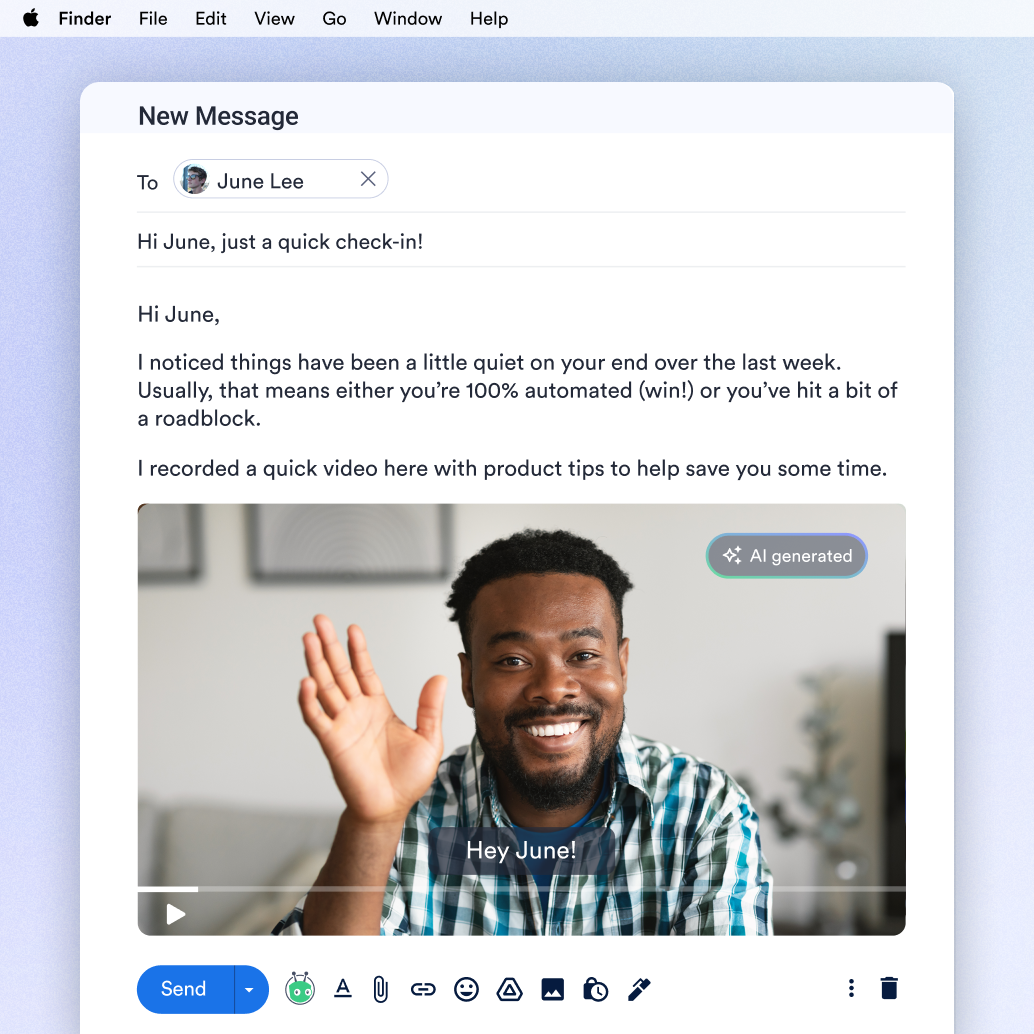
- Trigger-based check-ins (automated, AI Avatar): A user going inactive for seven days, skipping a key onboarding step, or engaging with a feature for the first time can all trigger an automated personalized videowithout any manual effort from the CSM. The relationship stays warm without adding to the workload.
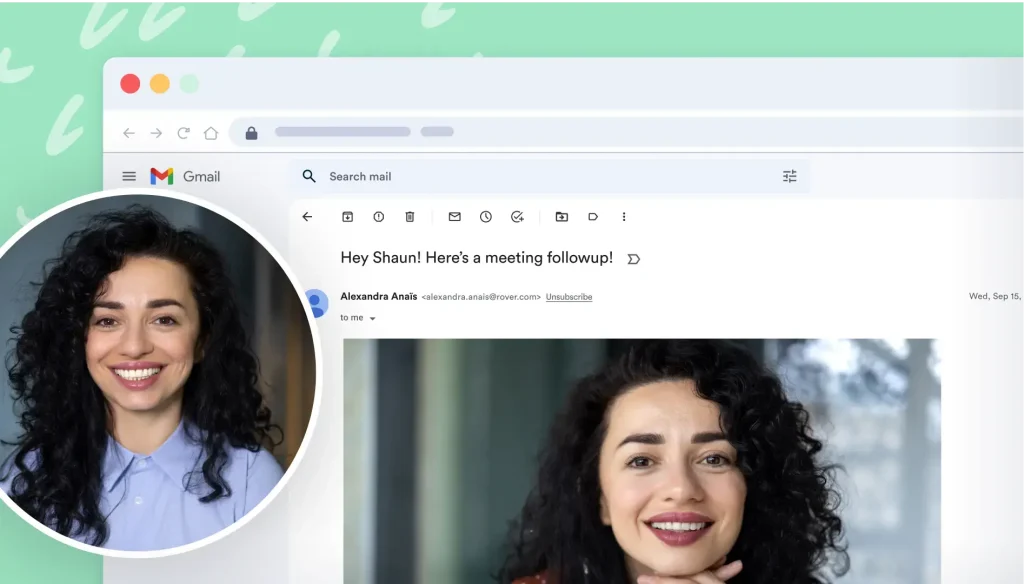
- Meeting recaps (recorded Message): After every strategic conversation, a short video recap confirms decisions, aligns on next steps, and reaches the stakeholders who weren’t in the room. Takes two minutes to record and replaces a long follow-up email nobody reads fully.
Where to begin: Start by mapping your customer lifecycle and identifying two or three moments between onboarding and renewal where communication typically goes quiet. Pick one and build a simple trigger for it, whether that’s a seven-day inactivity check-in or a milestone celebration video. Once that’s running automatically, add the next one. The goal isn’t to build the whole system at once. It’s to close one gap at a time until the silence between touchpoints stops being where customers disengage.
Outcome: Stronger relationships between formal milestones, earlier churn signals surfaced, higher expansion rates.
A note on measurement: Video engagement data adds a layer of signal that most CS tools miss entirely. If a customer was sent a product walkthrough and didn’t watch it, that’s actionable intelligence. If they watched 30 seconds and dropped off, that tells you something different than if they watched the full video and still didn’t adopt the feature. These are leading indicators, ones that NPS scores and health dashboards don’t capture until it’s too late to act on them.
The bigger opportunity
There’s a version of customer success that’s entirely reactive: respond to tickets, prep for QBRs, handle renewals as they come up. Most teams live here, not by choice, but because the workload doesn’t leave room for anything else.
But the teams consistently outperforming on retention aren’t doing more. They’re doing better at a smaller number of moments. They’ve identified where communication typically breaks down, day one, feature adoption, the quarter before renewal, the gaps between formal touchpoints, and they’ve built a system that handles those moments consistently, whether a CSM has ten accounts or a hundred.
Companies with dedicated customer success motions see up to 25% higher Net Revenue Retention than those without. The format of how they communicate is part of what separates them.
Protect the revenue you already have
Retention isn’t driven by one moment. It’s shaped by dozens of small interactions, most of which happen between the milestones teams tend to focus on.
The teams that win don’t communicate more. They communicate better at the moments that matter.
The revenue is already there. The question is whether your customers feel it.
Want to see how Vidyard supports post-sale teams across onboarding, QBRs, and retention workflows? See it in action.