
 Prospecting and Intros
Stand out and improve response rates.
 Sales
SalesGenerate more pipeline and close more deals.
 Sales Support
Set your sales team up for success.
 Marketing
Host video content and convert viewers into leads.
 Converting and Closing
Connect with buyers and close more deals.
 Corporate Comms
Create and deliver an internal communications strategy.
See Vidyard in Action →
“Personalized Vidyard video messages drove an 8x improvement in click-through rates and a 4x improvement in reply rates.” Read More
 Blog
BlogThe secrets to virtual selling and video best practices.
 Video Agent Hub
Case studies and how-to videos for every revenue use case.
 Knowledge Base
How-to and help articles for all things Vidyard.
 Fast Forward
Expert advice on all things virtual selling.
 Templates
Free sales templates for every stage of the deal cycle.
 FAQ
FAQGet the answers to your top Vidyard questions.
 AI Resource Hub
Guides and ideas for using AI in your workflow.
 Case Studies
Learn how our customers win more with Vidyard.






6 Best AI Sales Agents to Automate & Scale Your Outreach in 2025
Feb 5, 2025
·
12 min read

Roy Reif

Maximize your sales team's potential with AI sales agents. Learn about different types, compare top solutions, and find the perfect platform for your business.
We all know that using AI in sales is the hot topic—but we’re here to dispel the myths and get real about how sales teams can utilize AI sales agents to streamline the entire sales process. From identifying potential prospects to creating custom videos using AI avatars, we’ll show you some of the newest and best AI sales agent tools available now.
Table of Contents
What are AI sales agents?
AI sales agents use artificial intelligence to automate specific sales tasks by learning from your data. They’re not your average automation tech or just another chatbot. By using AI sales agents, teams have a better chance at identifying the right leads, communicating in the right way, and increasing sales velocity by (gently) pushing them through the pipeline faster.
In today’s increasingly tough sales environment—where two out of three reps are missing their goals—AI sales agents create a new opportunity for sales teams to maintain scalable, consistent, and personalized communication throughout the sales cycle. Best of all, the use of AI sales agents reduces the amount of manual work on each seller’s plate, so they can focus their time on high-value sales conversations and activities.
Types of AI sales agents
AI sales agents are different from general AI sales tools. Agents automate tasks 24/7/365, while AI sales tools may function more like a co-pilot for the task at hand. The sky is really the limit with the creative ways we’re seeing sales teams utilize AI sales agents, including our own team.
AI sales agents are generally designed to automate the most difficult and time-consuming parts of the sales process. This includes identifying high-value and buy-ready prospects, drafting personalized outreach, sending cold emails, sales coaching, and beyond. They can either do this by being completely autonomous agents or assistive agents.
Autonomous AI agents function independently, based on uploaded data, provided workflows, and algorithmic reasoning. Think of automatically sending outreach to prospects or AI-powered lead routing, almost like an AI SDR.
Assistive AI agents help individuals complete processes faster and more efficiently by using existing data and reasoning. One example is a sales training agent that your team can roleplay with to improve their messaging.
More specifically, examples of AI sales agents include:
- Lead scoring agents: Analyze your closed won/lost to find trends and automatically score new inbound leads.
- Prospecting agents: Communicate with prospects through chat, email, or video by automatically answering questions, setting meetings, and crafting agendas.
- Sales training agents: Onboard new sales reps and provide real-world scenarios to ensure your team is prepared with new product launches.
- AI avatars: Use hyper-realistic, hyper-personalized video messages with a digital twin of a sales rep using prospect data.
This new technology is powered by data and algorithms that are designed to ingest data, detect patterns, and enhance the human touch needed to close deals today. They aren’t meant to replace the sellers on your team—instead, they can be used to help salespeople take their efforts to the next level.
The top AI sales agents solutions of 2025
Now that you’ve got the basics down, let’s dive into specific AI sales agent solutions that solve a variety of problems that teams face today.
| Tool | Features | Pricing | Integrations |
|---|---|---|---|
| Vidyard | Custom or stock AI video sales agent; AI-assisted scriptwriting; trigger-based automation to deploy personalized AI outreach through sales and marketing platform integrations | Free tier available
Starting at $59 / user / annually |
LinkedIn, Salesforce, Salesloft, Gong, Apollo, Gmail, and many more |
| Salesforce Agentforce | Variety of pre-built AI sales agents for outreach, sales coaching, and generating pricing quotes | Contact for pricing | Designed to work with Salesforce ecosystem |
| Scratchpad | AI call summaries, suggested CRM updates, and sales coaching | Free tier available
Starting at $19 / user / annually |
AI notetaker works with Zoom, Gong and more; data integrates with Salesforce |
| Clay | AI-powered data enrichment and company research agent | Free tier available
Starting at $134 month / user / annually |
Dozens of integrations, including Salesforce, Salesloft, Outreach, and Hubspot |
| Crystal | AI-powered personality intelligence data | Free trial available
Starting at $49 month / annually |
Integrates with LinkedIn, Salesforce, Hubspot, Zoom, Gmail, and a few others |
#1: Vidyard
Vidyard is used by hundreds of thousands of businesses to unlock revenue opportunities through scalable, personalized video. Vidyard’s Video Sales Agent helps you automatically send personalized outreach at scale using triggers based on buyer engagement milestones. When those triggers are met, Video Sales Agent uses AI to autonomously generate and deliver personalized videos.
Top Vidyard features
- Video Sales Agent: Fully automate the creation and delivery of personalized video responses to customers based on pre-defined actions, so you can deliver the right message at the right time, anytime.
- Vidyard Video Messages: Create 4k videos throughout the sales process, build the perfect talk track using AI or pre-made templates, share your videos with the world, and measure your success using built-in video analytics.
- AI Avatars: Record once, then use your AI Avatar to deliver unique videos for each prospect, with tailored messages at scale. Send videos in over 25 languages, and increase your reach and efficiency without sacrificing the human touch.
- Vidyard Hosting: Upload, manage, and track your video content in one secure, central location. Organize with folders, protect with passwords, and gain valuable insights with robust analytics.
Pros of Vidyard
- Intuitive interface, no technical expertise required.
- Create your own hyper-realistic AI Avatar by recording a 90-second video, then use it to reach out to buyers at scale.
- Automatically personalize videos with customer data using customizable script tokens.
- Integrates with dozens of sales tools such as Salesforce, HubSpot, Outreach and Marketo, and even has a Chrome extension.
- In-depth video engagement analytics featuring view notifications and real-time viewer insights. Track video views, completion rates, and click-through rates to measure campaign effectiveness.
Cons of Vidyard
- AI Avatar videos are optimized for shorter messages to drive more immediate impact.
- Some advanced features may rely on integrations with third-party platforms.
Vidyard use cases
- Prospecting: Send personalized video emails to grab attention and stand out from the competition.
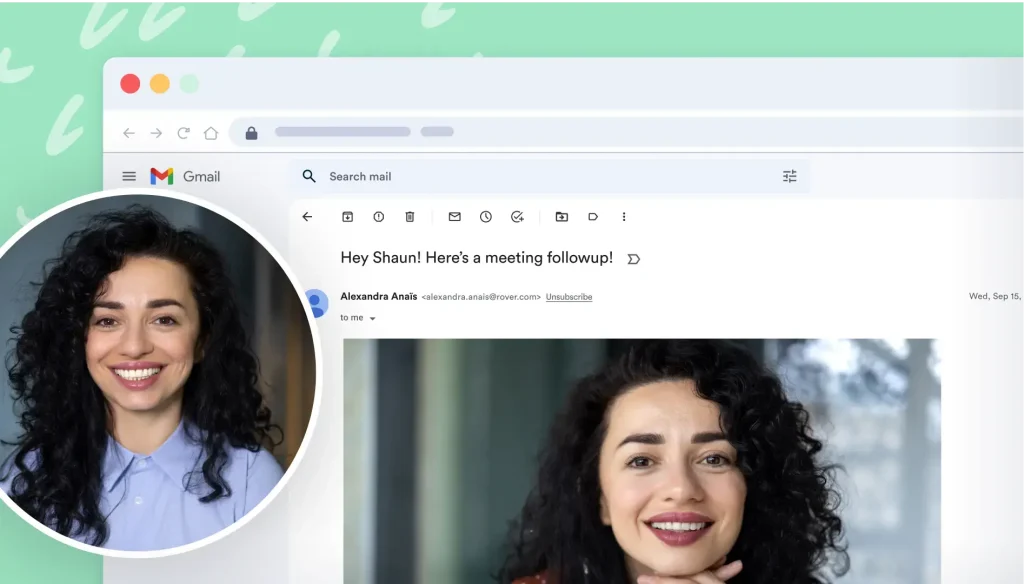
- Follow-ups: Increase close rates by following up on meetings or proposals with personalized video summaries and next steps.
- Sales nurturing/engagement: Record videos (like product demos and technical presentations) to support deals, close customers, and onboard new users in a way that builds relationships and increases customer satisfaction.
- Sales training: Onboard new sales reps and share best practices through video coaching and team-wide video libraries.

Record once to create your free AI avatar, then generate on-demand videos that bring personalization to scale.
#2: Salesforce Agentforce
Salesforce Agentforce’s suite of AI sales agents features customizable pre-built actions for sales training, nurturing inbound leads, and creating sales quotes.
Top Salesforce Agentforce features
- Automated lead nurturing with customizable guardrails using your CRM data and company content, like product FAQs, case studies, and sales plays.
- AI-powered sales coaching that enables roleplaying with custom scenarios to help teams handle objections, confirm decision-making power, and discuss pricing.
- Generate tailored sales quotes based on unified transaction and CRM data.
Pros of Salesforce Agentforce
- Offers multiple AI sales agents with unique functionality in one.
- Integrates seamlessly with other Salesforce solutions teams are already using.
- AI-powered sales quotes are unique AI sales agent functionality not found in other tools.
Cons of Salesforce Agentforce
- If not using Salesforce CRM, it may be difficult to utilize full capabilities.
- Given the technical nature of Salesforce platform, it could be difficult to get started.
- Pricing not available on the website.
Salesforce Agentforce use cases
- Lead nurturing: Can answer initial lead questions, handle objections, and schedule meetings using CRM and company data.
- Sales coaching: Enables teams to practice pitching, handle objections, and conduct realistic negotiations with an AI character that mimics real prospects.
- Conversation Intelligence: Records and processes sales calls to uncover customer objections, attitudes on pricing, and follow-up questions.
#3: Scratchpad
Scratchpad’s AI agents automate sales rep updates, coach team members, and improve CRM hygiene.
Top Scratchpad features
- Call Agent: Creates shareable call summaries, clips, and playlists while capturing next steps.
- CRM update agents: Improves data quality and process adherence without interrupting team workflows through custom CRM update templates.
- CRM coaching agents: Ensures that sales team member CRM updates include important data, including next steps, dates, roles, and objectives.
Pros of Scratchpad
- Offers multiple AI sales agents for different sales team needs.
- Can create automated deal rooms in Slack so teams can more easily collaborate on closing.
- Features other sales tools beyond agents to reduce repetitive tasks, including pipeline management, deal inspection, and sales compliance.
Cons of Scratchpad
- Very focused on its Salesforce integration.
- Confusing pricing and add-ons that make it difficult to understand what your team needs.
- Not all integrations are available on all tiers or plans.
Scratchpad use cases
- CRM hygiene: Can help ensure that your CRM data is up to date and accurate based on rules and traditional sales frameworks.
- Call note-taking: Automatically records, transcribes, clips, and summarizes sales calls.
- Mobile Salesforce updates: Enables faster and easier Salesforce CRM updates via mobile devices.
#4: Gong
Gong is a revenue AI platform that enables sales teams and leaders across the entire sales process—from capturing data to accurate forecasting and everything in between.
Top Gong features
- Signal detection: Gong’s technology identifies complex concepts, customer risks, and emerging trends to uncover data-driven insights and prevent deal slippage.
- Customized content: Generates relevant account briefs, follow-up emails, and internal updates using company and CRM data.
- Revenue prediction: With over 300 unique signals, Gong claims it can predict deal outcomes and forecast projections with unprecedented accuracy.
Pros of Gong
- All-in-one revenue platform with multiple tools for both team members and executives to complete complex tasks with ease.
- Technology also marketed towards customer success and marketing, enabling the full GTM team.
- Enables all sizes of teams, from startups to enterprises, with top-tier data privacy and over 250 integrations.
Cons of Gong
- Given all of its functionality, it can be complicated to get started and ensure you’re getting the most out of the technology.
- Pricing is unavailable on the website.
Gong use cases
- Go-to-market: Gong helps GTM teams understand what’s working and what isn’t with a ton of data insights so they can adjust their sales strategy quickly.
- Revenue forecasting: Gong claims their revenue prediction algorithms use 300+ signals and have 20% more precision than traditional CRM data algorithms.
- Automated outreach: From auto-dialers to workflows, Gong enables teams to scale their engagement while ensuring consistency across every team member.
#5 Clay
Clay enables data enrichment and automated personalized outreach for GTM teams by integrating over 100 data sources.
Top Clay features
- Data enrichment: Clay’s platform enables teams’ lead generation strategies with accurate contact data, firmographic data, and intent signals in custom workflows.
- Lead scoring: Easily create custom lead scoring models based on specific data points from existing customer data.
- Automated outbound: Automatically research target companies and craft unique outbound messages.
Pros of Clay
- Can source any data types with over 100 enrichment tool integrations and a customizable AI research agent.
- Enables teams to create target account lists, whether from scratch or based on existing companies in CRM.
- Large community and online presence to help GTM teams beyond the product.
Cons of Clay
- Online reviews state it can have a steep learning curve.
- Not great for small businesses that are targeting niche markets that aren’t internet-based businesses.
Clay use cases
- Cold outreach: Enables teams to create lists, collect all the data they need, and craft personalized emails with generative AI to increase conversion rates on initial outreach.
- Inbound enrichment: Teams can shorten the length of their forms by relying on Clay to enrich these inbound leads with relevant data automatically.
- Lead qualification: Extensive data about prospects and inbound leads makes it easy to understand if they match your ICP.
#6: Crystal
Crystal markets itself as “the personality data platform” that helps sales teams understand how best to communicate with specific prospects based on personality types.
Top Crystal features
- Personality data: Helps teams understand a prospect’s personality type, giving insight on how prospects like to communicate in order to better predict customer behavior.
- Personalized content suggestions: Provides real-time suggestions into what words and phrases resonate best with specific prospects.
Pros of Crystal
- Unique type of data not found within other types of data enrichment providers.
- Has a Chrome extension, along with integrations into leading sales tools.
Cons of Crystal
- Requires annual subscription, even if using the self-service tool.
- Uses data found on LinkedIn to analyze personalities—if the lead doesn’t have a robust LinkedIn presence, data can be less accurate.
Crystal use cases
- Sales engagement: From sending the first cold email to getting the decision-maker’s buy-in, personality data can help ensure you’re communicating in the prospect’s style.
- Hiring: HR teams can analyze candidates in the hiring process.
How to choose an AI sales agent
AI sales agents are becoming a must-have. But how do you know which ones are right for your team? The last thing you want to do is to fall for the hype, invest time and budget into one of these tools, and ultimately come away frustrated when you don’t see the results you intended.
Here are six criteria for how best to test AI sales agents so you can jump in with confidence.
#1: Know your goals
As always, you should know what you’re trying to achieve by implementing a new tool. Are you trying to automate time-consuming tasks? Get more accurate and consistent CRM data? Engage prospects with more personalized outreach? Once you know your goal, you can start to evaluate different providers.
#2: Check your tech stack
Many of the sales tools you’re already using are likely adding AI sales agents into their existing product, like Salesforce, Gong, and many others. Rather than trying a new provider, it might be best to add in this new functionality within a tool you already use. However, you should still look at what else is out there—even if your provider has a solution, it might not be the best for your use case.
#3: Test each AI sales agent
Because AI agents are a new concept, teams aren’t totally sure how to evaluate if they’re working, or if they’re the best at what they do. That’s why you should spend time watching product demos, talking with sales teams, and testing out multiple products using the same prompts or trying to solve the same problem. Teams can create a rubric to evaluate different tools based on essential features.
Here are some examples:
- How the AI agent handles misunderstandings or failures
- How much you can customize an AI agent
- Pricing
- Integrations with your current sales tools
#4: Review data privacy
AI is powered by big data…but how will your company’s data be used? Review the data security and privacy measures in place, including how customer information is stored, processed, and protected. If you don’t want your company’s data used in their training models, the tool should let you turn this setting off.
#5: Ensure AI sales agents integrate with your tools
What’s the use of a new AI sales tool if it doesn’t play nicely with the other tools you’re using? Given that many new companies are popping up in this space, you should check twice to make sure that an AI sales agent can integrate into the tools that manage your workflows and sales processes.
#6: Consider all the costs
Consider the total cost, including implementation, training, maintenance, and any usage-based fees that scale with your business needs. AI sales agents often have usage-based pricing, so you’ll want to be sure you fully understand how much it could cost when adopted across the entire team.
How to secure team buy-in for an AI sales agent
Many teams have experienced sales tools that promised the world but actually created more headaches, delivered less accurate data, or led to more manual work. Make sure that as you look at investing in AI sales agents, you get buy-in from those who will interact with it the most—usually SDRs, BDRs, Account Executives, Account Managers, and Customer Success Managers.
Try this tactic: This quarter, ask each team member to try out one new AI tool and discuss the results in a group setting.
Securing buy-in from the bottom up is often the best way to ensure team adoption. At the end of the day, adopting new technology and tools is all about revenue growth. That comes from increasing productive sales activity, reducing manual tasks, and analyzing customer interactions. Being able to point to distinct increases in these key metrics help you prove the value of a new tool like an AI sales agent.
Close up to 25% more deals with the right AI sales agent
Vidyard stands out amongst the sea of AI sales agents by focusing on the part of the sales process that is proven to drive more engagement: Personalized video messaging.
Your team can create AI Avatars that look and sound exactly like them. Reps can then use those Avatars to automatically generate hundreds of personalized videos that match your brand and get buyers’ attention. And with our Video Sales Agent, you automatically generate and send videos to buyers, triggered by specific actions in your CRM or sales enablement tools.
Over 100,000 teams already use video and Vidyard to build relationships and scale up personalized buying experiences that close up to 25% more deals.
Read our 2025 Video in Business Benchmark Report for exclusive insights on how sales teams are using AI and video throughout their process. You’ll also get recommendations and playbooks for putting AI video to work within your team.
Record once to create your free AI avatar, then generate on-demand videos that bring personalization to scale.