

 Prospecting and Intros
Stand out and improve response rates.
 Sales
SalesGenerate more pipeline and close more deals.
 Sales Support
Set your sales team up for success.
 Marketing
Host video content and convert viewers into leads.
 Converting and Closing
Connect with buyers and close more deals.
 Corporate Comms
Create and deliver an internal communications strategy.
See Vidyard in Action →
“Personalized Vidyard video messages drove an 8x improvement in click-through rates and a 4x improvement in reply rates.” Read More
 Blog
BlogThe secrets to virtual selling and video best practices.
 Video Agent Hub
Case studies and how-to videos for every revenue use case.
 Knowledge Base
How-to and help articles for all things Vidyard.
 Fast Forward
Expert advice on all things virtual selling.
 Templates
Free sales templates for every stage of the deal cycle.
 FAQ
FAQGet the answers to your top Vidyard questions.
 AI Resource Hub
Guides and ideas for using AI in your workflow.
 Case Studies
Learn how our customers win more with Vidyard.







Your Guide to Conversational AI for Sales
Aug 1, 2023
·
7 min read

Lori Connor

Learn how to start using conversational AI to save you time, better engage your prospects, and drive more deals.
Conversational AI for sales is an evolution of the common chatbot. You’ve used a chatbot before, right? You type a question in the chat box, and an automated program gives you an answer.
But a chatbot is only as smart as the information it’s been programmed with. If you ask a question that the chatbot doesn’t know how to answer (like “help me find the right product” or “explain the moral implications of Asimov’s Three Laws of Robotics”), you’ll quickly find that this helpful tool becomes more of a hindrance.
That’s where conversational artificial intelligence (or AI) comes in. It’s a new way for you to engage with your leads, prospects, and customers. In this guide, we’ll tell you all about conversational AI for sales—including how it works, how you can use it, and why it’s in your best interest to get started with it, pronto.
Ready to start? Read on!

Let AI be your assistant and create sales scripts for you.
Table of Contents
What is Conversational AI?
Conversational AI is a framework that helps computers interact with humans in a more natural way. Siri, Alexa, and Google Assistant are all examples of conversational AI.
A conversational AI listens to what the user is asking and supplies the best answer it can based on the user’s unique request.
Two important technologies underpin conversational AI:
- Natural language processing. This lets the AI read or listen to the user’s input, analyze it for context and meaning, and develop a fitting response.
- Machine learning. This lets a conversational AI refine and improve its output based on previous input it’s received. Translation: As the AI has more interactions with humans, its conversational abilities become better and better—kind of like how a real human learns.
Sales Use Cases for Conversational AI
So what does conversational AI mean for sales? It’s not going to replace your sales team…but it can be a fantastic point of contact early in the buyer’s journey, setting up a smoother trip through your sales funnel.
There are multiple ways to put conversational AI to work for selling. Here’s an overview of two major sales use cases for conversational AI: Chatting and sales coaching.
Chatting
Let conversational AI do what it does best: Have conversations.
For instance, if you’re already using a chatbot on your website, you can build conversational AI into it. Before AI, that chatbot probably only had a few pre-programmed talk tracks. But with AI, it can hold actual conversations with users, providing information and gathering data on the prospect’s behavior and interests.
Here’s the sort of things that a chat tool powered by conversational AI can do:
- Generate and qualify leads. Every sales team strives to increase the quality of its leads—and conversational AI can help you do just that. It can pick out relevant info from its interactions in order to ID new leads and pre-qualify them before sending them along to your sales team.
- Upsell and cross-sell. Because conversational AI can grasp the context of a conversation, it can spot and suggest upsell or cross-sell opportunities.
- Feed your CRM. Conversational AI can connect to your CRM platform, automatically feeding the data it harvests from its interactions into your system.
Sales Coaching
Conversational AI can also help sharpen your skills via sales coaching. Some sales training companies now offer AI-powered sales roleplay tools, where the AI simulates the behavior of the prospect or customer. Or you can even use tools like ChatGPT to help with sales role play exercises.
Alternatively, AI can analyze reps’ delivery during roleplay (or real-world) selling situations and suggest improvements.
4 Benefits of Conversational AI for Sales
Put simply, conversational AI for sales teams can make your life a lot easier. Here are four ways how:
- Drive more sales. Back in 2019, Forbes found that chatbots increased sales by an average of 67%…and that was before the AI boom.
- Handle lower-value tasks. Conversational AI can automate time-consuming tasks like lead nurturing, data capture, and customer support. This frees up sales reps’ time to focus on higher-value tasks, like building relationships and closing deals. If you’re looking to automate even more of the sales process, you might also consider using AI sales agents. Agents can handle personalized outreach, lead scoring, and other routine tasks, making your entire sales workflow more efficient.
- 24/7 service. Humans need to sleep; AI doesn’t. A conversational AI is a great stand-in for when your human sales reps aren’t available. No matter what time of day (or night) a prospect reaches out, a conversational AI can ensure that they receive an experience that’s comparable to chatting with a real, live rep.
- Engagement and personalization. Conversational AI can deliver more personalized and human-like responses than a bog-standard chatbot can. This helps prospects and customers build higher-quality relationships with your brand from the get-go. It can even offer tailored recommendations, promotions, and support.
3 Examples of Conversational AI Solutions for Sales
The AI boom led to a huge influx of conversational AI solutions and tools. We’ve picked out three solutions to give you a general idea of what’s out there on the market.
(Note: With the AI field evolving so rapidly, these overviews are subject to change.)
Conversica
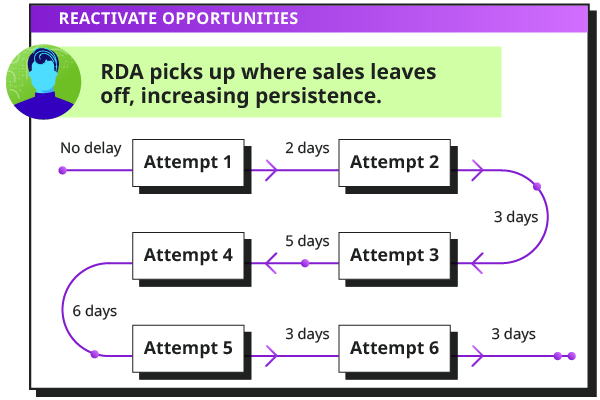
Conversica’s Revenue Digital Assistant is a sales-focused conversational AI that automates low-level sales tasks.
The AI can be a first point of contact for new leads, qualify those leads before hand-off to a live rep, follow up with prospects who have gone cold after initial outreach, or restart conversations with former customers to win them back.
DRUID
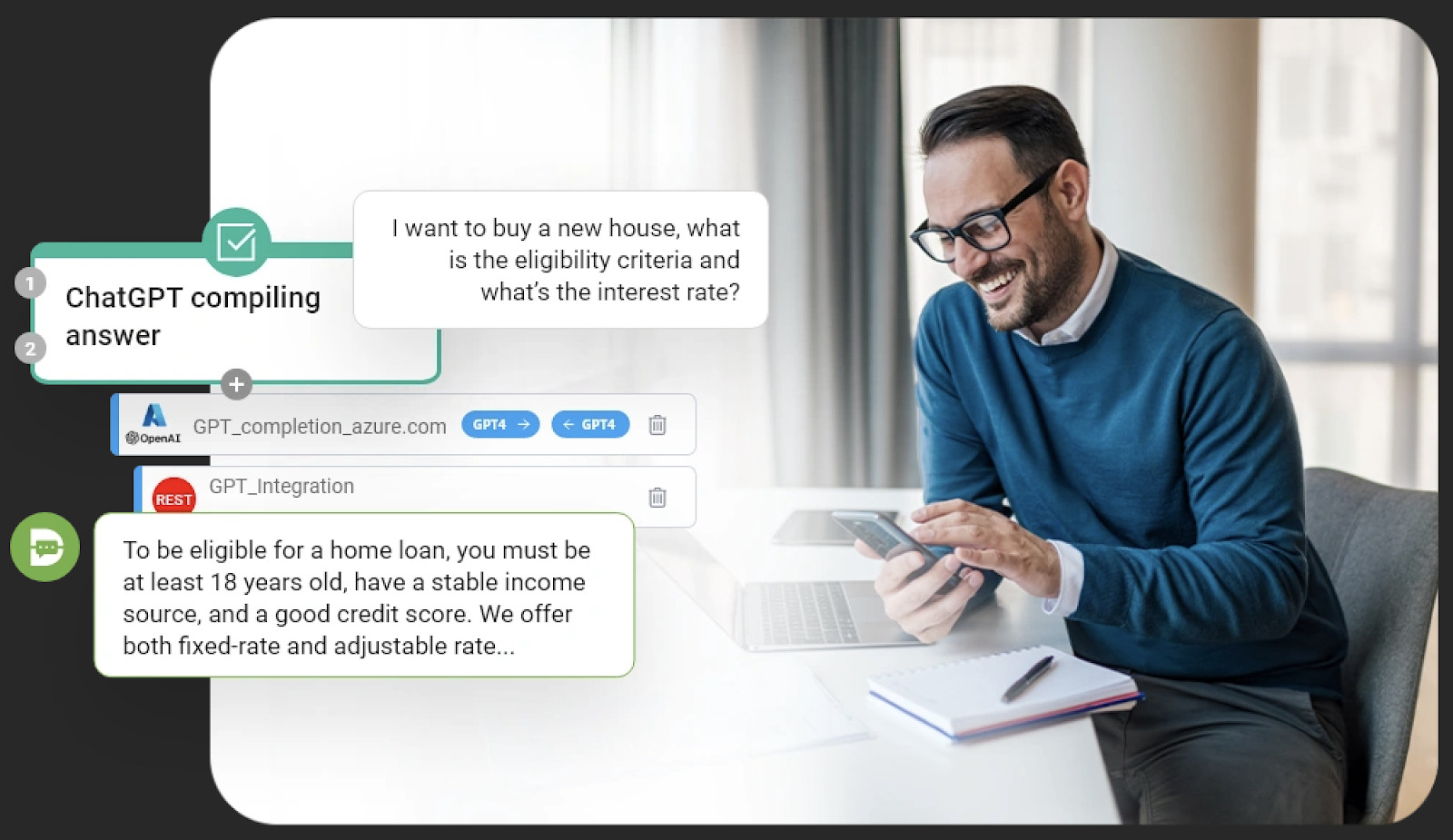
DRUID’s conversational AI solution aims to capture and score leads, manage conversations with prospects to maximize engagement, and guide leads along their ideal customer journey. It boasts a solutions library that includes over 500 skills in pre-built templates.
Uniphore
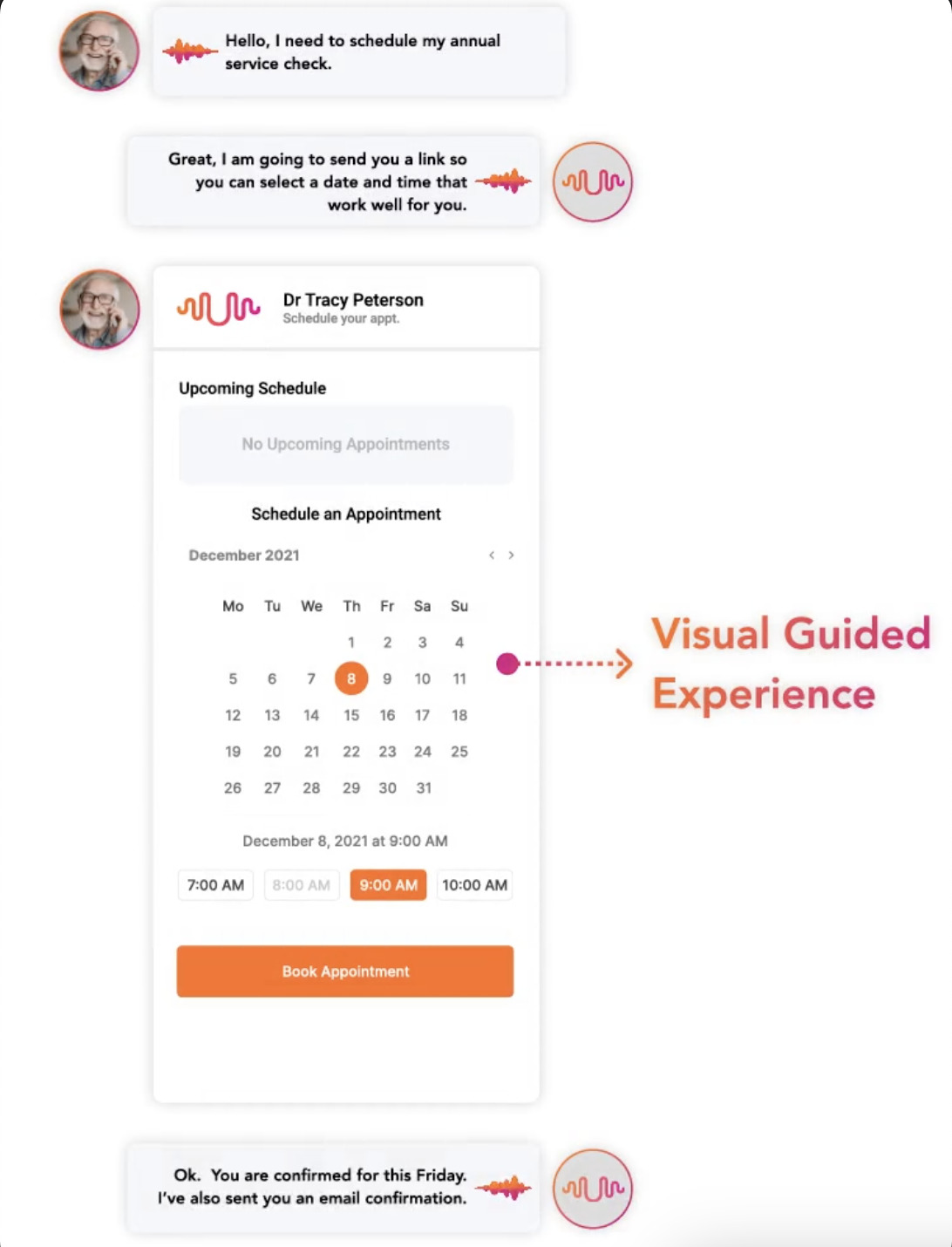
While Uniphore’s AI-powered virtual assistant focuses more on customer service, it can also be deployed as a sales tool. It lets users self-serve key activities in their customer journey without needing a live rep.
The AI pulls information from your website, documents, or knowledge base to provide accurate responses and helps users accomplish tasks like booking meetings or upselling products based on their needs. Users can interact with the AI through text or voice input, making it a great cross-channel fit.
If the conversation does need to escalate to a human rep, the tool includes context info about the user’s interactions so that the rep can pick up where the AI left off.
4 Best Practices for Implementing Conversational AI in Sales
We won’t get into the nitty-gritty detail of setting up your own conversational AI here, but when you do settle on your preferred AI tool, here are a few best practices worth keeping in mind.
- Identify your goals. Define which sales objectives you want conversational AI to help with. Boosting conversions? Increasing prospect or customer satisfaction? Shortening your sales cycle?
- Understand your target audience. Understand who will be interacting with your conversational AI. What are their behaviors, preferences, or pain points?
- Customize and train your AI model. If possible, customize your natural language processing and machine learning models to reflect your brand’s voice, your sales team’s messaging, and your customer’s journey.
- Monitor and improve. Refine your conversational AI on an ongoing basis. Incorporate feedback from your sales team and the people interacting with the AI. Additionally, analyze your conversational AI is performance on your sales metrics, and use that info to optimize your AI and the sales process surrounding it.
AI’s usefulness in selling goes way beyond just conversations. Sales Feed’s Chris van Praag explains how you can use ChatGPT to crank up your productivity and close more deals.
Conversational AI: A Game-Changer for Your Sales Team
Conversational AI has the potential to totally transform how your sales team interacts with prospects and customers. Just keep in mind that it’s still an emerging technology: While it can come pretty close to emulating a human, it can’t perfectly replicate one, and it definitely won’t be replacing your sales reps any time soon.
With this info in your pocket, get out there and explore the world of conversational AI! You may find that it’s the perfect fit for your sales team.
Interested in learning more? Check out our full guide on using AI in sales.
Let AI be your assistant and create sales scripts for you.