

 Prospecting and Intros
Stand out and improve response rates.
 Sales
SalesGenerate more pipeline and close more deals.
 Sales Support
Set your sales team up for success.
 Marketing
Host video content and convert viewers into leads.
 Converting and Closing
Connect with buyers and close more deals.
 Corporate Comms
Create and deliver an internal communications strategy.
See Vidyard in Action →
“Personalized Vidyard video messages drove an 8x improvement in click-through rates and a 4x improvement in reply rates.” Read More
 Blog
BlogThe secrets to virtual selling and video best practices.
 Video Agent Hub
Case studies and how-to videos for every revenue use case.
 Knowledge Base
How-to and help articles for all things Vidyard.
 Fast Forward
Expert advice on all things virtual selling.
 Templates
Free sales templates for every stage of the deal cycle.
 FAQ
FAQGet the answers to your top Vidyard questions.
 AI Resource Hub
Guides and ideas for using AI in your workflow.
 Case Studies
Learn how our customers win more with Vidyard.






8 Sales Tools to Help You Increase Pipeline in 2025
Jul 7, 2025
·
12 mins

Vidyard

This in-depth guide explores the latest and greatest AI-powered sales tools including the types of tools needed today, top sales tools, and how to choose the right sales tools for your business.
Pipeline in 2025
When was the last time you reviewed the latest and greatest features from your existing sales tools? Have you checked out any new sales tools recently?
Halfway through 2025, we can confidently say that AI has transformed sales tools across the board — not just standalone assistants, but the very nature of engagement, personalization, and pipeline management.
Which is why you don’t need another general guide to the best sales tools.
What you really need is an in-depth guide to help your modern GTM team choose the right AI-powered sales tools and features that align with today’s selling environment: where buyers expect less friction, more personalization, and instant value.
That’s why we’ve spent time talking to our colleagues, customers, and reading online reviews of dozens of tools to synthesize the top 8 sales tools to supercharge revenue teams.
The modern sales stack is AI-augmented
Sales teams who aren’t using AI are falling behind their competitors: a recent report from Garther shows that sellers who effectively integrate AI tools into their processes are 3.7 times more likely to hit their sales quota.
The good news is that a majority of the top sales tools teams already use are adding in AI-powered features. According to Hubspot, 87% of surveyed salespeople say AI integrations within existing tools have increased their usage of the technology.
We believe that every sales tool and team member can benefit from AI – here’s just a few ways this technology is revolutionizing the industry:
- Predictive analytics to help with sales forecasting and pipeline analysis
- Crafting personalized cold outreach and sales enablement material
- Lead qualification and lead routing
- Sales onboarding and training
- Behavior-based follow-up strategies
- Scalable video content creation using AI avatars
As we dive into our list of handpicked sales tools, we’ll highlight the top AI features and how teams are already using them to achieve better, faster results.
6 essential types of sales tools
We all know the basic sales tech stack: a customer relationship management platform, prospecting tools and data sources, and a way for leadership to have the data they need to make critical decisions.
However, you might not realize how artificial intelligence and big data is helping take these basic sales tools to the next level. Let’s get into the top types of sales tools high-performing teams are using and the ways AI has taken them to the next level.
Customer Relationship Management (CRM)
The best CRMs help revenue teams centralize data, track interactions, and ensure that prospects are making their way through the sales funnel.
While many platforms already had advanced features like built-in lead scoring and pipeline forecasting, artificial intelligence has helped these data-powered features be more effective and accurate. However, a majority of AI-enhanced features in CRMs have focused less on leadership and management and more on empowering reps to be their best with advanced features like automated lead enrichment and customizable AI sales agents.
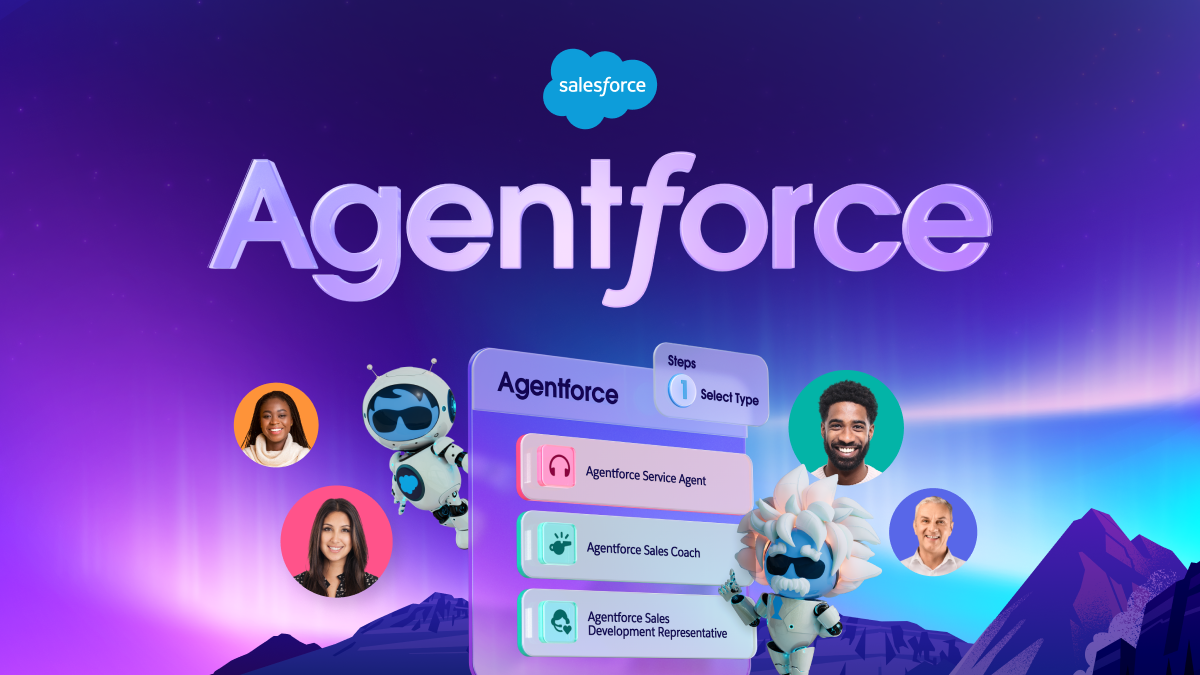
Salesforce, arguably the largest CRM platform in the world, has focused their AI efforts on Agentforce and Salesforce Einstein, their native generative, predictive, and autonomous AI. They’ve been investing in artificial intelligence and machine learning for years, enhancing their position in the market as a leader and innovator.
Another top CRM is Hubspot, who has acquired several companies over the past few years to enhance their AI capabilities including Dashworks, Frame AI, and Clearbit. They seem focused on helping SMBs utilize AI, announcing 200+ new features tailored to their needs including a prospecting agent and Workspaces, a unified space to research prospects, prioritize leads, and close deals.
Sales Engagement Platforms (SEP)
While a CRM helps manage the data and keep track of interactions, a sales engagement platform (SEP) is where the sales action happens. They help teams automate outreach, create and manage sales cadences, and provide insights into sales campaign effectiveness.
A sales engagement platform is like the engine of a car, where all of the action that progresses deals forward happens including streamlining communication with leads via email, calls, and social media while offering features like templates, sequences, and call tracking.
In this next iteration of SEPs, artificial intelligence is enabling hyperpersonalized emails with generative AI, enhanced scheduling, and even helping team members know how best to communicate with each member of the buying committee.
Sales Analytics and Reporting Tools
Salespeople, managers, and leaders have always relied on data coming out of CRMs – but this next generation of sales analytics and reporting tools helps them both get more granular insights while also being able to see the forest for the trees.
From being able to identify individual team member performance to forecasting revenue for the year, sales analytics and reporting tools are often built into sales platforms like CRMs and SEPs.
Artificial intelligence is helping leaders have more accurate insights and predictive analytics to help them interpret pipeline risk, team performance, and other critical sales KPIs like sales velocity and customer acquisition costs.
Lead Generation and Prospecting Tools
A majority of sales teams still rely on outbound prospecting efforts, which makes having lead generation and prospecting tools that integrate easily into your CRM to help identify high-quality leads critical.
These platforms not only help sales teams identify companies that fit their ideal customer profile, they also ensure they have accurate contact data including email addresses, phone numbers, and job titles.
The next generation of these tools use AI to surface intent indicators, help automate lead routing and lead prioritization based on data signals, and often offer generative AI to help write cold emails and cold cold call scripts.
Proposal and Document Management Tools
You can’t celebrate a deal until the paperwork is signed – and that’s where tools like DocuSign, PandaDoc, and Proposify come in. These tools make it easy to create, send, and manage proposals, contracts, and renewal documents.
The AI embedded into these tools include AI-assisted data extraction, renewal alerts, and risk spotting to help ensure both the buyer and seller are fully informed and aware of the most important parts of the agreement.
Video Sales Tools
Video selling platforms empower sales teams to break through busy inboxes and help them build authentic, personalized connections with prospects at scale. What’s great about video is that it can be used throughout the sales process: cold outreach, meeting follow-ups, objection handling, and complex product demonstrations.
Sales teams who use video in their sales process achieve better results than their counterparts: more than 60% of surveyed sales reps reported increased response rates and nearly half report that it has increased close rates.
Artificial intelligence has drastically increased the ability to scale video creation with AI-generated scripts, AI avatars that no longer require teams to manually record each video, and video agents that can send real-time personalized videos based on the actions prospects take like requesting a demo or attending a webinar.
What’s great about video is that it can be used throughout the sales process: cold outreach, meeting follow-ups, objection handling, and complex product demonstrations.

Record once to create your free AI avatar, then generate on-demand videos that bring personalization to scale.
The best 8 sales tools for exceeding pipeline goals
As we mentioned earlier, our goal is to provide a comprehensive, validated list of the best sales tools that are using AI in innovative and effective ways.
We’ve curated this list based on customer reviews, third-party mentions, case studies, and awards to identify tools that create measurable results, improve efficiency, and drive better outcomes.
1. Salesforce
G2 Score: 4.4 out of 5 stars
Salesforce offers a comprehensive suite of sales tools designed to support every stage of the sales cycle, from lead generation to deal closure. With features like Sales Cloud, customizable dashboards, opportunity management, and robust CRM capabilities, sales teams can streamline their workflows, track customer interactions, and maintain a clear view of their pipeline.
In addition to its core sales functionalities, Salesforce leverages cutting-edge AI through its Einstein platform. Einstein AI empowers users with predictive lead scoring, intelligent forecasting, automated insights, and personalized recommendations for both reps and sales leaders.
Key features
- Powerful CRM software that centralizes customer data, tracks interactions, and manages the entire sales pipeline with customizable workflows and real-time reporting.
- Einstein AI delivers predictive analytics, automated insights, and intelligent recommendations to help sales teams prioritize leads, forecast revenue, and personalize outreach.
- Streamlines sales processes with automated task management and seamless integrations with tools like Slack, marketing platforms, and third-party apps to enhance productivity and collaboration.
Pros and Cons
Pros
- Allows for deep customization of workflows, dashboards, reports, and automations, enabling teams to tailor the platform to their exact sales processes.
- With the Salesforce AppExchange and native integrations, users can easily connect thousands of third-party tools and internal systems, making it a true hub for all sales operations.
Cons
- Salesforce’s extensive features and customization options can make initial setup and onboarding time-consuming, especially for smaller teams without dedicated Salesforce admin support.
- For businesses with straightforward sales processes, Salesforce may feel overly complex or feature-heavy compared to leaner CRMs like Pipedrive or Hubspot Sales Hub.
Pricing
Starts at $25/user/month (Sales or Service Cloud basic plans) and scales from there based on user seats, features, and add-ons.
2. Gong

G2 Score: 4.8 out of 5 stars
Gong is an all-in-one Revenue AI Platform that enables teams to streamline processes, access actionable insights with purpose-built AI, and drive sales pipeline. They offer four separate sales tools including Gong Engage, Gong Forecast, Gong Agents, and Gong Data Engine.
Their unified approach to helping revenue teams from account insights, outreach, and coaching gives those who invest in the platform a comprehensive suite of tools.
Key features
- Records and analyzes sales calls using AI to surface insights on talk patterns, objections, and key topics.
- Flags at-risk deals, scores pipeline health, and delivers real-time forecasts for holistic lead management.
- Uses custom “smart trackers” and generative AI to summarize calls, suggest coaching points, and automate follow-ups.
Pros and Cons
Pros
- Users consistently praise Gong for being straightforward to set up and navigate.
- Gong stands out for its ability to capture and analyze customer conversations, making it a valuable resource for coaching, performance improvement, and team oversight.
- Over 250 integrations including syncing with CRM systems, email platforms, and Slack.
Cons
- Some users describe Gong as somewhat clunky when switching between modules like “Conversations” and “Engage.”
- Users also note that search and filtering functions can be slow or unreliable when working with large volumes of data.
Pricing
Gong’s pricing is available upon request and depends on team size and feature utilization.
3. Vidyard

G2 Score: 4.5 out of 5 stars
Vidyard is an AI-powered video selling platform over 100,000 teams use to create and send personalized video messages at scale.
We make it easy to create video sales scripts, record videos, and utilize in-depth analytics to understand what’s resonating with prospects. Over the last year, we’ve doubled down on using AI with the introduction of our AI Avatars and our Video Agents.
Watch this 1 minute video to learn more about Vidyard.
Key features
- Easily record personalized one-to-one videos and receive instant notifications when they’re viewed.
- Automate the creation and delivery of tailored video messages triggered by specific actions in your CRM or sales tools with Vidyard’s AI Avatars and Video Agents.
- Identify high-performing scripts and CTAs and share across your entire sales team to boost engagement, strengthen prospect connections, and close more deals.
Pros and cons
Pros
- Simple integrations with over 50 leading sales tools to integrate video throughout the sales process.
- User-friendly interface with ability to customize videos with brand logos and colors.
- AI Avatars enable teams to create hyper-realistic personalized videos without manual time and effort.
Cons
- Some features like Video Agents and AI Avatars are available on Teams and Enterprise plans.
- Designed for short-form personalized video messaging versus long-form marketing related videos such as webinars or video podcasts.
Pricing
Free trial with pricing available on request.
4. Highspot
G2 Score: 4.7 out of 5 stars
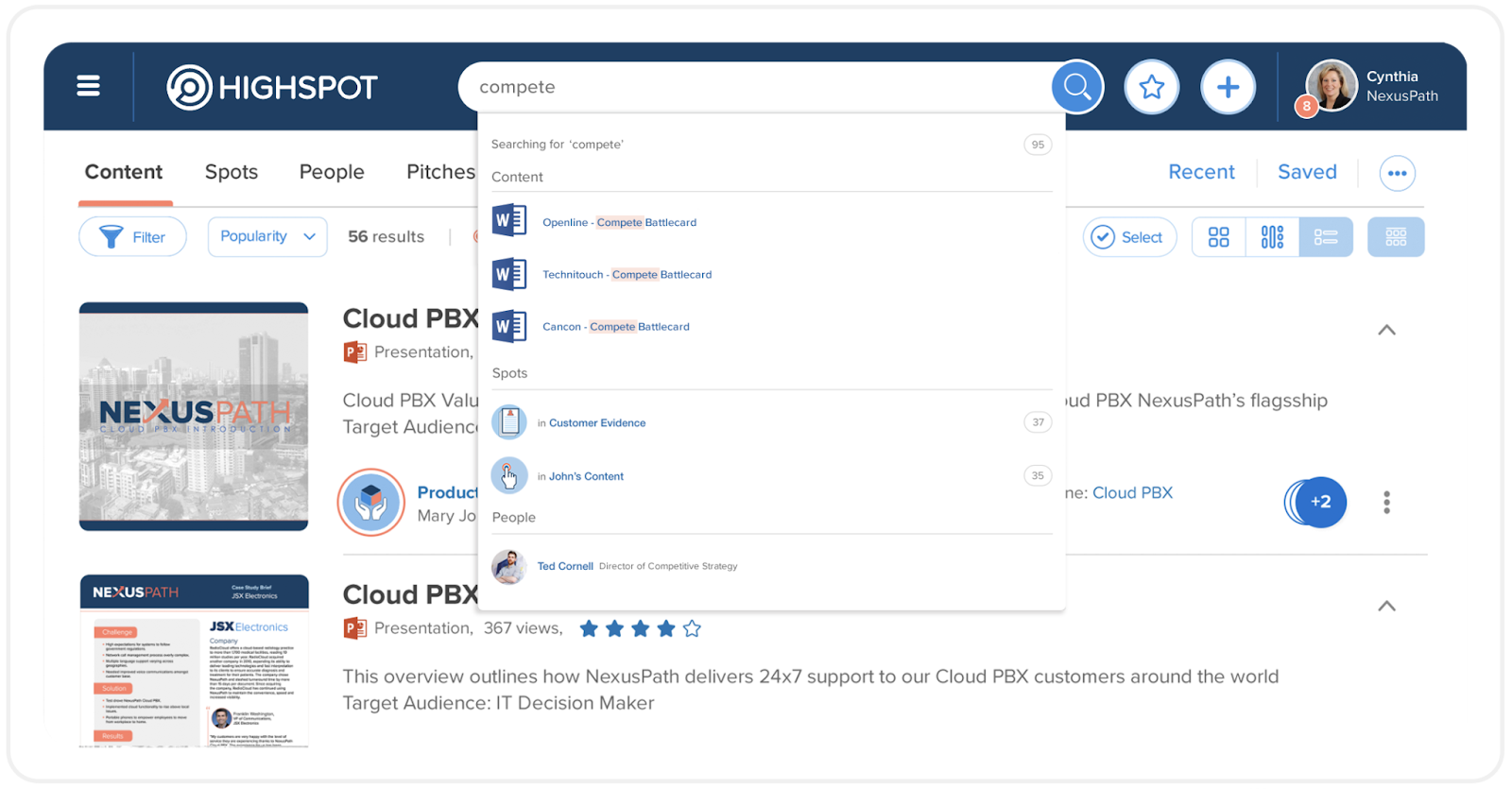
Highspot is an enterprise sales enablement platform designed to improve sales productivity, increase GTM efficiency, and accelerate business results. Used by companies like Nvidia and Fedex, their technology combines a variety of disparate tools and features including sales enablement content generation, sales training and coaching, and partner enablement.
Key features
- Organize, update, and govern all sales and marketing collateral in one place with AI-powered search, templates, secure file sharing, and automated content audits.
- Teams can build dynamic, personalized digital rooms with real-time tracking of buyer interactions to deliver interactive prospect experiences and analytics to help teams understand what’s resonating.
- Gain visibility into content performance, rep skills, and buyer engagement with scorecards, AI insights, and conversation intelligence.
Pros and Cons
Pros
- Many users highlight Highspot’s clean design and intuitive interface.
- Sales leaders appreciate its deep reporting capabilities for content performance and coachable moments.
Cons
- Highspot takes time to set up and onboard users to ensure users have a comprehensive understanding of its capabilities.
- Its rich feature and pricing set may be overkill for smaller organizations with tighter budgets.
Pricing
Highspot’s pricing is available upon request.
5. Substrata
G2 Score: 4.9 out of 5 stars
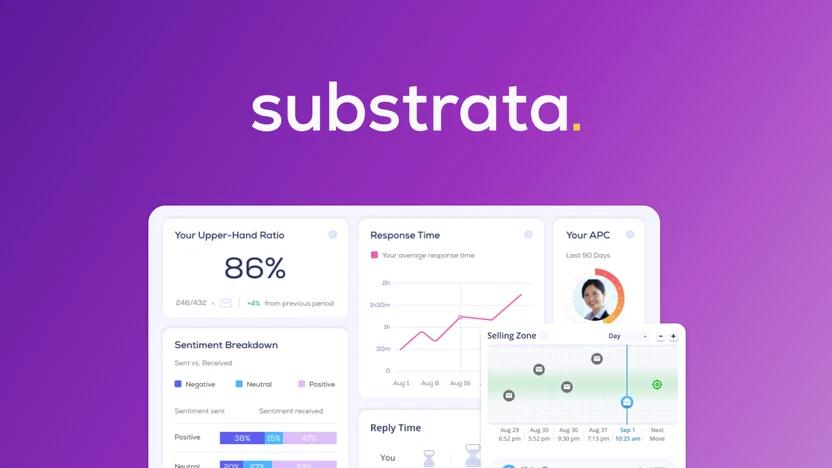
Substrata is an AI-powered Social Signal Intelligence platform that helps revenue teams analyze behavioral data to uncover attitudes, emotions, and intentions of prospects and customers. Their technology is a great add-on sales tool for teams who have the basics covered and want a way to extract deeper insights into behavioral tendencies like interaction styles and sentiment shifts based on analyzing language of calls, meetings, and emails.
Key features
- Substrata uses AI to analyze your emails and conversations, detecting hidden buyer intentions, emotions, attitudes, and power dynamics to help adjust their strategies.
- The platform offers robust tracking of team activities, giving sales managers visibility into communication patterns and pipeline behaviors.
- By applying predictive analytics and social-signal AI, Substrata delivers data-driven coaching tips, and real-time suggestions on email outreach.
Pros and Cons
Pros
- Users say Substrata excels at uncovering hidden buyer intentions, emotions, and power dynamics in calls and emails that may not be obvious.
- Substrata brings emails, meetings, and proposals together in one place, keeping teams organized and collaborative in all sales efforts.
Cons
- Many users mention that mastering Substrata takes time—its rich features can feel overwhelming at first.
- The platform’s advanced capabilities come at a premium price, which may be burdensome for smaller organizations.
Pricing
Substrata starts at $50/user/month billed annually.
6. Zoominfo

G2 Score: 4.5 out of 5 stars
Zoominfo is a go-to-market intelligence platform that started as a b2b contact data provider and has since expanded to offer AI copilots, conversation intelligence, and sales automation. Zoominfo acquired Chorus.ai and Comparably, helping them expand into helping marketing and talent teams with robust data and analytics.
Key features
- Gain access to a constantly updated database of over 600 million business profiles and contact information with built in list generation and lead segmentation.
- Monitor real‑time buyer intent through trigger signals—such as site engagement spikes, funding announcements, and leadership changes.
- Automatically record, transcribe, and analyze calls, emails, and chats to gather insights on sentiment, talk patterns, and coachable moments.
Pros and Cons
Pros
- ZoomInfo’s new Copilot offers AI-driven lead scoring, account summaries, Buying Group mapping, email generation, real-time alerts, and Slack integration.
- Users praise ZoomInfo for its large, up-to-date B2B contact database, especially for mid-to-large enterprises.
- Users highlight its easy implementation, thorough onboarding process, and native integrations including LinkedIn Sales Navigator.
Cons
- The platform’s breadth of features means it can feel overwhelming to new users.
- ZoomInfo’s pricing, especially with advanced features, can be unrealistic for SMBs.
Pricing
Pricing available upon request.
7. Salesloft
G2 Score: 4.5 out of 5 stars
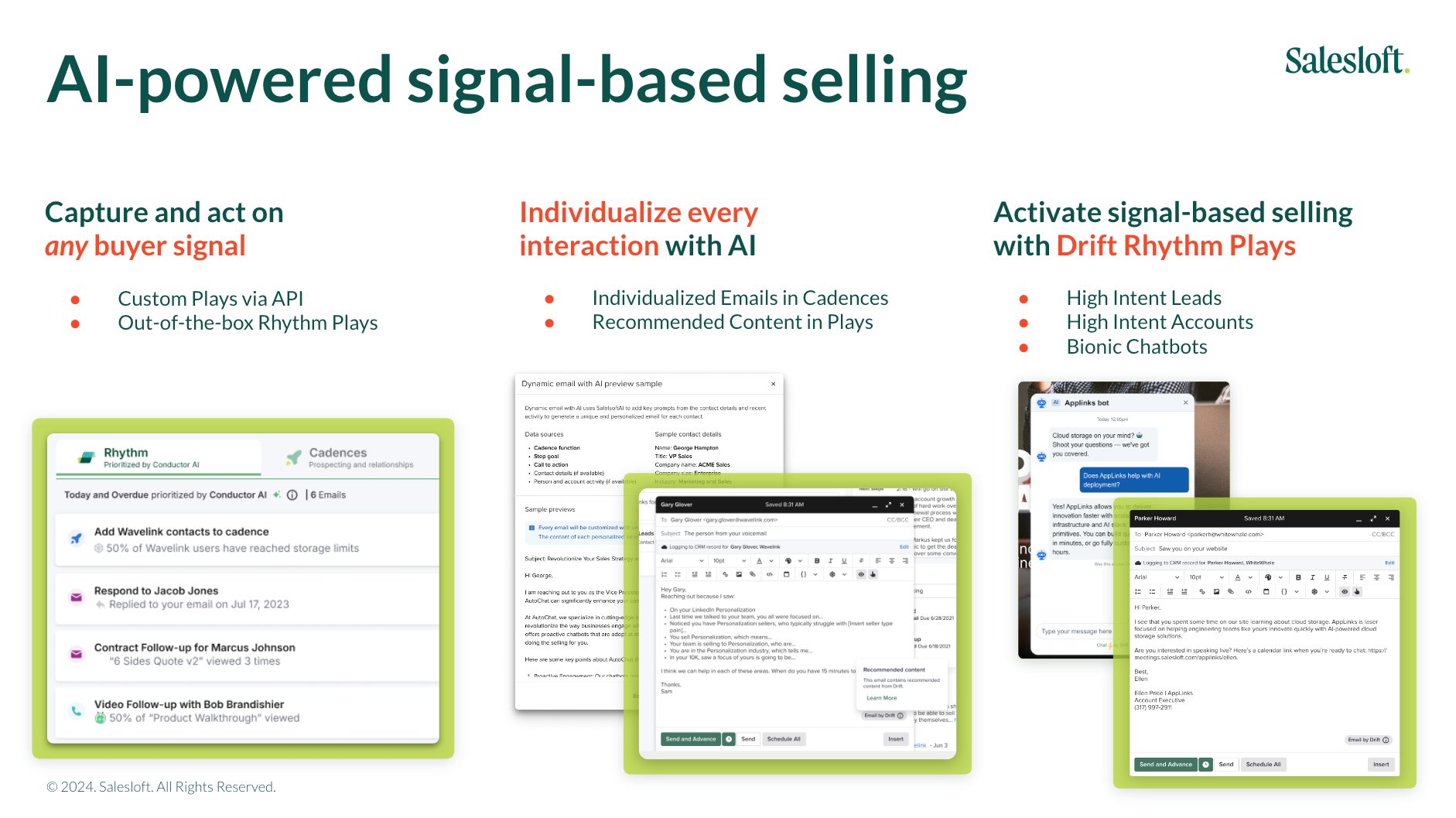
Salesloft is a revenue orchestration platform that uses purpose-built AI to help teams prioritize and take action on the most important deals. Their platform features a variety of tools including I chat agents, sales engagement, sales intelligence, conversation intelligence, deal management, and forecasting.
Key features
- Teams can build structured, automated sequences that combine emails, calls, LinkedIn touches, SMS, and more.
- Automatically records, transcribes, and analyzes calls and meetings with built-in AI to extract key moments, objections, competitor mentions, and coaching opportunities.
- Rhythm, Conductor, and Deal Engagement Scoring can prioritize high-impact activities, identify at-risk deals, and predict revenue with live metrics and insights.
Pros and Cons
Pros
- Salesloft’s cadence sequences help manage high-volume email, call, and social outreach without losing personalization.
- Users find Salesloft easy to use and navigate, enabling reps to become productive quickly with minimal training.
Cons
- Some users report call quality problems, email send limits, and inconsistencies in logging activities.
- While basic functions are intuitive, mastering advanced capabilities and workflow customization can be challenging, especially if no admin support is available.
Pricing
Pricing is available upon request.
8. Scratchpad
G2 Score: 4.8 out of 5 stars
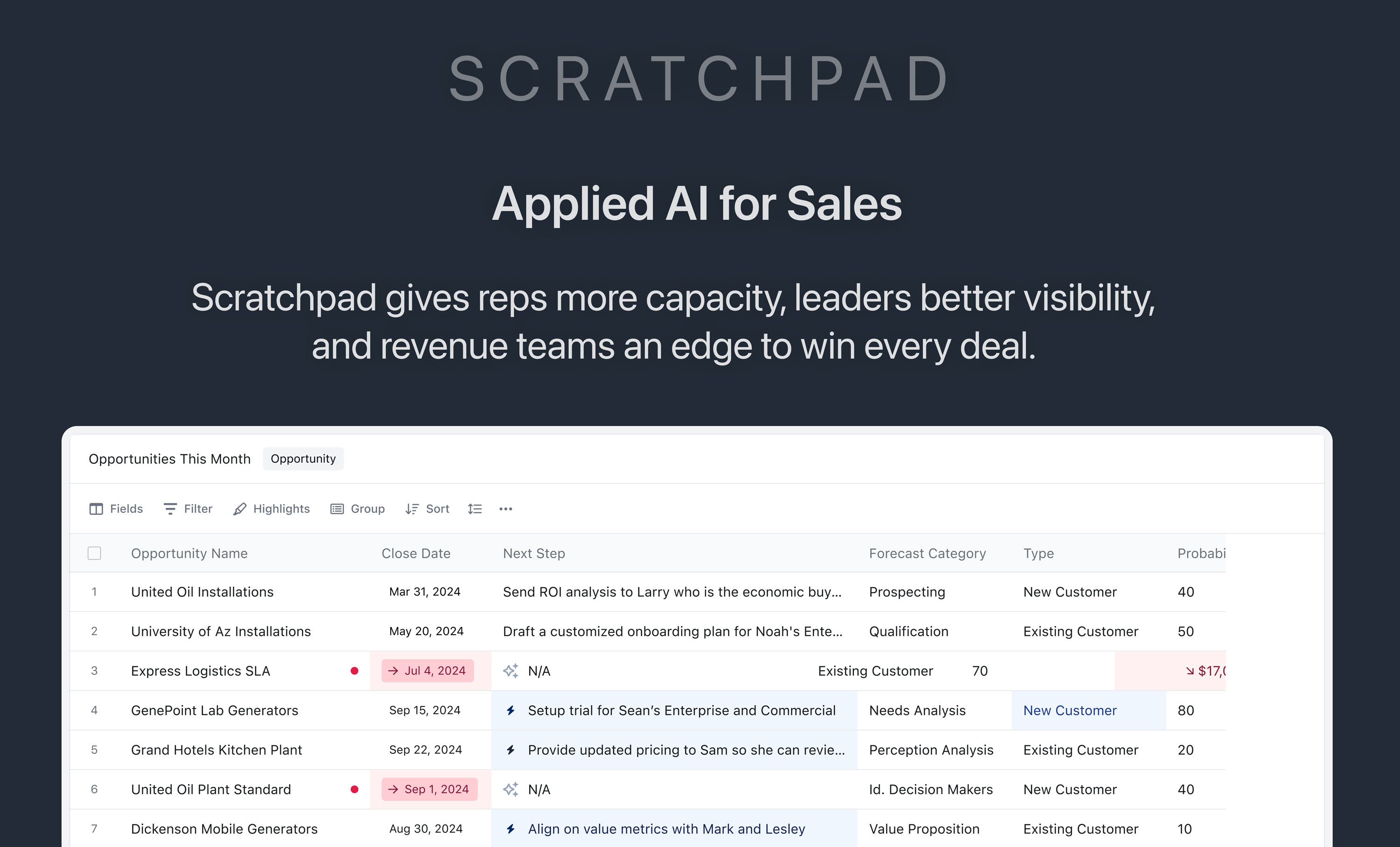
Scratchpad is an AI-driven CRM Hygiene system that ensures teams and leaders have accurate and up-to-date information. Their platform features automated CRM updates including call recording and analysis, AI generated pre- and post-call sales notes, alerts to ensure reps are staying on top of deals.
Key features
- Scratchpad incorporates built-in hygiene alerts, coaching suggestions, and AI scoring based on sales methodologies like MEDDIC, BANT, or SPICED.
- Scratchpad’s Sales Agents analyze calls and notes to suggest or automatically update key CRM fields meaning no manual data entry.
- Get instant answers from Agents that analyze deal history, account data, and calls to increase rep productivity.
Pros and Cons
Pros
- Users report saving significant time as tasks that usually take minutes in Salesforce can be done in seconds with Scratchpad.
- It embeds directly into Salesforce workflows (via Chrome extension), allowing users to update records without switching applications.
Cons
- Scratchpad is designed specifically for teams that use Salesforce.
Pricing
Scratchpad starts at $19/user/month billed annually.
How to choose the right sales tools for your business
While every team wishes they could have every tool, that’s not reality for most companies. From budgets to privacy needs, being able to identify the right sales tools is an art form — but one that can be learned, especially with these tips.
1. Define your sales goals
Chances are you’ve heard of the big players in the space, which may make you default to using tools like Salesforce or Hubspot. However, these might not be the best fit for your team’s needs — which is starting out with a clear understanding of sales goals is critical when evaluating new teams.
You might not need all the shiny features a pricy tool comes with but instead need to ensure that the basics are top notch and can be tailored to your needs. So as you look at adding a new tool into your sales tech stack, understand the specific goals you’re trying to achieve such as making follow-up easier, having more accurate contact data, or ensuring leadership has actionable insights that don’t take a long time to gather and analyze.
2. Prioritize tools that integrate AI naturally
We all know that AI has flooded the sales technology market… but is it actually a good thing? You want tools that will grow and scale with not only your team but with how selling is changing in this new age of advanced technology.
You want to make sure that the tools you evaluate aren’t stuck in the past but also aren’t trigger happy with integrating AI in a bunch of useless ways that end up being a huge distraction to your team.
So look at how each tool is thinking about AI and how they’re making decisions about new AI features. A great way to understand this is to look at user review sites like G2 or TrustRadius and even platforms like Reddit to get honest feedback from real users.
3. Evaluate scalability and adaptability
Dozens of brand new sales tools have popped up over the last year… but will they be there next year? Do they have the team and funds to continue building features and functionality as they find product market fit?
Maybe more importantly, do they have the ability to scale with your team and adapt to how you work? For example, if you are a venture-funded SaaS company, you know that high-growth is in your future and you may want to invest in a robust platform like Salesforce. But if you’re a small business, a CRM like Pipedrive with some built-in prospect and customer engagement tools might be best.
Just like you will scale and adapt, your sales tech needs to as well.
4. Compare pricing against total potential value
Some companies put their pricing on their site while others may hide it behind a demo request form. While there will always be a debate on what’s better, the pricing you see or find online might not be the total price you end up paying.
Whether necessary features are locked unless you upgrade or the flat rate fee doesn’t account for AI features (especially relevant for platforms that may charge usage fees for certain AI tools), pricing isn’t always so transparent.
Beyond the actual price you pay monthly, there are soft costs to integrating new sales tools including setup, team onboarding and training, and maintenance. Make sure you’re factoring all of these things in as you make the pitch to get the budget and predict ROI for a new tool.
5. Run trials or pilots
Many companies offer free trials, especially if their platform is a self-service tool, while more expensive tools will likely provide pilots with customer support holding your hand to ensure you are understanding all features and functionality.
Either way, as you start the process of testing out and comparing new tools, make sure you have a list of questions you want answered in the trial or pilot. You should also test out the integrations with your other tools, as you may find that while companies advertise easy integrations, it’s actually more difficult or your settings don’t align with their defaults.
The more you’re likely to pay for a tool, the more willing the vendor should be to ensure a successful pilot! They should also have support material that can help your team get up to speed and understand all features.
Discover how Vidyard empowers sales teams
Here at Vidyard, we’ve seen the power of personalized video time and time again. We also drink our own champagne over here, and using our AI Avatars our sales team achieved overwhelmingly positive results: 5x more replies and 4x more meetings booked!
Video could be the sales tool your team is missing. With our latest launch of Video Agents, teams can unlock the power of video across every interaction with no extra time or effort!
See exactly how Vidyard can empower your sales team by scheduling a demo today.